The passing away of Bangladesh’s former and first woman Prime Minister Khaleda Zia comes as a tragic but favourable moment for her party (politics is full of ironic paradoxes), the Bangladesh Nationalist Party (BNP). Her son Tarique Rahman’s return to his native country and ill mother five days before her death was timed to perfection in more ways than one. It is often difficult to ascertain whether fate dictates politics, or politics dictates fate. But politics does control the fate particularly of modern lives and nations. Gandhi understood way back in 1920 that politics encircles our lives “like the coil of a snake”.
Let me focus here on something that hangs like a sword over the form that politics takes in Bangladesh, determining the nature of retributive politics as well as the struggle over the meaning of its sovereignty: the challenge of secular democracy against the shadow of religious politics.
As I have said in a previous article in Frontline, the Awami League represented a vision and politics of secular democracy in Bangladesh much before the Liberation War of 1971. It dropped its “Muslim” middle name in 1955 and opposed the draft of Pakistan’s first constitution in 1956, which declared it an Islamic Republic.
Members of the Islamic Right in Bangladesh represented by the Jamaat-e-Islami did not just openly side with Pakistan and its genocidal army in 1971 but took part in perpetrating crimes against their own people. The logic behind their criminal passion is obvious: they felt that breaking away from Pakistan would weaken (the myth of) the homogenous religious identity that the Muslim League had argued and fought for. They effectively precipitated the tragedy of Partition. Those who belonged to the Jamaat or shared its concerns did not mind the hegemony of Urdu over Bengali or the north Indian Muslim elite ruling over Bengali-speaking Muslims from the east.
The Awami League fought against (the idea of) Pakistan under the banner of linguistic and cultural autonomy, breaking away from the Muslim League’s vision of the early 1930s that led to the demand for Partition in 1940. It speaks of some remarkably staunch secular motivations in a country that was violently carved out in the name of religion.
The Pakistan vision was shared by Bengali Muslim politicians of the Muslim League, like Huseyn Suhrawardy, who played a dubiously communal role during Partition. The genocide of Bengali Hindus in Noakhali in 1946 would have been impossible without Suhrawardy and the complicity of the Bengal Provincial Muslim League (a branch of the Muslim League), and the evidence is chilling. The Jamaat is a product of the League’s ideology of religious separation, dominance, and even coercion. Banned after the 1971 war, the Jamaat regained legitimacy through Ziaur Rahman, who founded the BNP, a party composed of people from the army and the Muslim League. This was the first act of betrayal of a secular possibility in Bangladesh’s political history since 1947.
Rahman’s daughter Khaleda Zia, as the leader of the BNP and the country’s first woman Prime Minister in 1991, broke the Islamic right-wing code of women being unwelcome in politics. She is also commended for choosing the parliamentary system over the presidential one, paving the way for electoral democracy in Bangladesh. However, she did not hesitate to enter into an alliance with the Jamaat in 1999 that brought her to power in 2001.
Zia’s reign saw widespread violence against the Hindu minority (similar to the acts of vandalism and brutality against Hindus in Bangladesh since July 2024). Her objection to the Farakka Barrage to divert Ganges water and her refusal to grant India transit rights through Chittagong port are today hailed as tough nationalist gestures against Indian hegemony. It is conveniently forgotten, however, that Zia’s regime made Bangladesh a notorious safe haven for ethno-nationalist separatists from India’s north-eastern region and encouraged Islamist jihadists like the Hefazat-e-Islam from within. It was Zia who banned Taslima Nasreen’s books (beginning with Lajja in 1994, a novel on a Hindu family terrorised in Bangladesh in the aftermath of the Babri Masjid demolition) and legitimised the jihadist attack on the writer that forced her to take asylum in India.
The return of the religious right
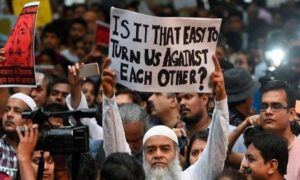
Currently, Bangladesh is out on the streets to remake history by abandoning its secular past and embracing its religious hard-line credentials. The Awami League’s crimes are being coupled with its secular credentials. It seems the baby must be thrown out with the bathwater. The return of the religious right, including students who were part of the July 24 uprising, marks a tendency to return to 1947 and 1975. (Sheikh Mujibur Rahman was assassinated in 1975 in a military coup. The military rule, which lasted until 1990, removed constitutional secularism and simultaneously facilitated the rise of the Islamic Right by removing provisions against religion-based parties like the Jamaat). Bangladesh dreams its future in the name of a selective past.
The youth of Bangladesh marched in 2013 in the memory of Jahanara Imam, a martyred mother of the 1971 war (after Sheikh Hasina formed the war crimes tribunal following her coming to power in 1998), and demanded capital punishment for the Jamaat leader Abdul Quader Molla for his role in Imam’s death. In 2024-25, the new generation of Bangladeshi youth marched the streets of Dhaka demanding the trial and execution of Hasina. The tribunal Hasina installed has now condemned her to death.
This is a remarkable mimetic act being performed in Bangladesh’s political culture. The changing ideology of the perpetrator in question is as important as the nature of the crime itself. Molla betrayed his country by indulging in fratricidal violence in the name of religious nationalism, while Hasina presided over a repressive regime that persecuted political opponents and critics in the name of secular nationalism and earned the epithet “fascist”.
The political language after the July 2024 uprising against Hasina replaced secularism with a religious vocabulary in Bangladesh’s imaginary. Secularism has become associated with Indian hegemony. But notice the irony: the sentiments against Hasina are largely being dictated by men who either follow or are merging with religious nationalist men like Molla. The former enemy does not just replace the latest in Bangladesh’s political merry-go-round, but even his ideology becomes worth emulating.
It is important at this juncture to address the most critical issue of how secular nationalism went wrong during Hasina’s regime. Take the case of Mir Ahmad Bin Quasem, a UK-returned barrister and political activist. He joined the legal team in defence of his father, a Jamaat politician who was convicted of murder and kidnapping in 1971 by the International Crimes Tribunal. In the middle of the trial, Bin Quasem was thrown into the Hasina regime’s dreaded secret detention centre, the Ayna Ghar or the House of Mirrors, run by the intelligence-cum-state police, and became a victim of forced disappearance. Bin Quasem’s father might have been guilty of war crimes. His ideological complicity with counter-revolutionary Islamists seems apparent and his attempts to seek reprieve through US agencies appear dubious. This was nevertheless no reason—and against every ethic of democracy—to victimise his barrister son and torture him for eight years.
Hasina’s secular regime inevitably made martyrs out of religious fundamentalists by using coercive and extra-legal measures against them. This emboldened their aggrieved sympathisers to stir public opinion against the regime. This is an important reminder for secular regimes around the world. The problem and threat of religious fascism cannot be resolved by brutally suppressing its practitioners. It requires ethical fairness to impress the principles of democracy upon society. Flouting constitutional rules to suit ideological and political ends does not serve in deepening public consciousness towards a democratic sensibility. Instead, it is the best way to destroy the ground for democracy in nations where the religious challenges are high.
The politics of fundamentalism and communalism is based on appeals to religion. Secular states and politics must engage with the theological and political aspects of religion through public debates and critical education (especially in the university). Otherwise, people would get the impression that the secular polity and its intellectual class have weak arguments against faith. To ignore its responsibility of tackling such politics weakens the life and idea of secularism. It also keeps the threat of a political takeover of fundamentalist and communal forces alive. However, if a secular state persecutes religious fundamentalists in its paranoia, it loses the plot.
The spokeswoman of Amnesty International, Champa Patel, airing her views on behalf of her organisation that raised concerns about the trial of Bin Quasem’s father, said that even though the people of Bangladesh deserve justice for the crimes committed against them, taking recourse to public execution would create wedges within society. In other words, she pointed out the dangers of retributive politics.
Creating a secular political system
In a recent television show, the maverick Bangladeshi thinker and writer Farhad Mazhar argued that one cannot think of creating a secular political system by either ignoring or rejecting Islam (or religion, in a wider sense) because then one would create possibilities for extremism. Determining the place and limits of religion in a secular polity is a complex issue. Faith relegated to the “private” sphere, especially in unsecular societies, can create a double life. The secular state must create a common ethic of responsibility in a multireligious society. If “freedom to offend”, to use Salman Rushdie’s phrase, is fundamental to (secular) free expression, the ethic of communal responsibility alone can ensure non-violent responses. Mazhar also argued that neoliberalism was responsible for the kind of religious fascism witnessed in Bangladesh and India today. When people’s lives are miserable, they will tend to drift towards religion and the promise of afterlife.
These arguments have an unexplored connection with Bangladesh’s origins. The Muslim subaltern class (mainly the peasantry) was responsible for the 1946 genocide against Hindus in Noakhali. It established in East Pakistan what Walter Benjamin called in his famous 1921 essay as “mythic” or “founding” violence. The point Benjamin makes about this violence is that even as it is keen to create a new law (of the state, of governability), it paradoxically does not know where, and how, to end. The vow of—and appeal to—infinite martyrdom in Bangladesh is mythic.
Nations created out of such excess violence keep repeating the cycle, as one can witness in Bangladesh today where mobs are burning down people and buildings. It is reminiscent of the horror of 1946. There is a demonic exorcism in this subaltern style of violence. The spectral horror indicates that it is not simply the body of the enemy that has to be eliminated, but also the shadow. The opposite of this is what Benjamin calls divine violence, a form of messianic force that is paradoxically vulnerable or weak, where the law is accepted without spilling blood and where justice is finally made possible. Gandhi unleashed such a paradoxical force of historical justice in the 20th century. But he could not overcome the mythic violence of history.
The word “justice” (and its equivalent “insaaf”) appears everywhere in Bangladesh today but alongside the rhetoric of retribution. Breaking away from the National Citizen Party (NCP)—whose decision to align with the Jamaat led to the disgruntlement and exit of some of its leading women members—the NCP’s thoughtful joint convenor, Samantha Sharmin, said in an interview that she envisions a Bangladesh where a woman wearing jeans and T-shirt would be as acceptable as a woman in a burqa. Sharmin is thinking about democracy (including inner-party democracy), and the relationship between gender and democracy, unlike the ideologically messy and instrumentalist male founders of her party who are willing to compromise democracy for religious politics.
In a statement to the media on May 7, 2025, on the occasion of Rabindranath Tagore’s 164th birth anniversary, Tarique Rahman paid tributes to Tagore, acknowledging that the “contribution of the world poet in all aspects of our national life is undoubtedly undeniable”. This is a crucial and hopeful gesture at a moment when radicals in Bangladesh are demolishing cultural icons. It remains to be seen if Bangladesh can stop the retributive cycle and seek new, messianic justice through democracy.
[Manash Firaq Bhattacharjee is the author of Gandhi: The End of Non-violence. Courtesy: Frontline magazine, a fortnightly English language magazine published by The Hindu Group of publications headquartered in Chennai, India.]