❈ ❈ ❈
Whose Life Counts? Anjel Chakma’s Death and the Idea of India Today
Swarati Sabhapandit
The death of Anjel Chakma, a 24-year-old student from Tripura, in Dehradun, confronts the Indian republic with a disturbing constitutional reckoning. Attacked by a group of men after objecting to a racial slur, Anjel succumbed to his injuries days later. What should have prompted swift action instead unfolded through delay and institutional inertia. The first information report (FIR) was registered two days after the assault, allowing the main accused to remain absconding. This delay once again exposes how the urgency of justice continues to be unevenly distributed within the republic.
Describing the killing as a “horrific hate crime,” leader of the opposition in the Lok Sabha Rahul Gandhi located Anjel Chakma’s death within a wider political climate in which hate is not accidental but cultivated and normalised. Whether one accepts this diagnosis or not, the intervention underscores a deeper truth that racialised violence against citizens from the Northeast is neither new nor episodic. It reflects a longstanding crisis of belonging, where constitutional citizenship exists formally but remains fragile in everyday life. Anjel Chakma died not only as an individual victim of violence, but as a constitutional subject whose vulnerability exposes the fault lines between rights on paper and protection in practice.
While assessing the relationship between free speech and constitutional democracy, legal scholar Ernest Freund (in 1919) placed some faith in the free flow of discussion on matters affecting the nation. For Freund, democratic vitality depended on the coexistence of heterogeneous and opposing viewpoints. A similar faith animated the moment of Indian independence, when access to political space was imagined as a collective achievement rather than a selectively conferred entitlement. The Indian constitution, adopted in 1950 in the name of the people, sought to institutionalise this faith by recognising citizens as equal right-bearers capable of participating in shaping the nation.
Yet, the persistence of racialised violence, particularly against people from the Northeast, reveals how conditional this equality remains. Anjel Chakma’s death forces us to ask a fundamental question: who is protected by the constitution, and whose vulnerability is routinely normalised? When crimes rooted in racial slurs are met with administrative delay, they signal not only a failure of law enforcement but a deeper erosion of constitutional commitment.
Writing in 1997, Sunil Khilnani had described India’s history as a curiously unmappable terrain, full of fissures and unsuspected linkages. That terrain feels acutely unsettled today. Communal polarisation, institutional erosion, and the narrowing of dissent have transformed the phrase “the idea of India” into a site of intense political contestation. Anjel Chakma’s killing, followed by protests in Tripura and demands for a trial outside Uttarakhand, reveals how far the republic remains from securing equal dignity across its territorial and cultural margins.
To ask what the idea of India entails today is therefore not an abstract exercise. It is a political and constitutional necessity. It requires returning to the foundational commitments of the republic – the anti-colonial struggle, the debates in the Constituent Assembly, and the constitutional imagination that sought to hold together extraordinary diversity through rights rather than hierarchy. It also requires acknowledging that the idea of India is fragile and contested project, sustained through democratic negotiation rather than cultural conformity.
The constitution as a site of interaction
The framers of the constitution were acutely aware of this fragility. They were drafting a document for a deeply hierarchical society structured by caste, patriarchy, religious difference, and economic inequality. B.R. Ambedkar repeatedly warned that democracy in India could not be reduced to mere periodic elections. Drawing on the concept of constitutional morality, he insisted that democracy required an ethic of restraint, public reasoning, and mutual respect and that these are values that would have to be consciously cultivated. His caution against the tyranny of the majority resonates sharply today, when racial slurs, hate crimes, and judicial delays are increasingly absorbed into the background noise of public life rather than treated as constitutional emergencies.
As India embarked on its independent journey, the constitution emerged as a site of everyday interaction between citizens, the state, and existing social authorities – caste, religion, class, and patriarchy. This marked a decisive departure from colonial governance structured primarily around the relationship between ruler and ruled. Over time, ordinary citizens came to understand that the Constitution mattered not only in courtrooms but in daily negotiations with power. When that shared understanding fades, and violations no longer disturb the public conscience, it marks a deeper democratic malaise.
The ambition behind the constitution was transformative. It sought not merely to establish representative government but to democratise society itself. Granville Austin famously described this as a “seamless web” connecting democracy, social revolution, and national unity. Yet India’s political history reminds us that the social hierarchies the constitution sought to dismantle did not disappear. They persisted, often reasserting themselves within modern institutions in subtler forms. Anjel Chakma’s death reflects precisely this tension.
‘An unfortunate incident’
Today, however, this tension has hardened into a political fault line. A resurgent majoritarianism seeks to anchor national identity in a singular civilisational narrative, redefining citizenship in terms of cultural conformity rather than constitutional values. This shift normalises suspicion towards minorities, legitimises surveillance of dissent, and renders some lives more lamentable than others. In such a climate, the death of a young tribal student does not register as a constitutional crisis but as an unfortunate incident—quickly politicised, selectively mourned, and soon forgotten.
The erosion of institutional autonomy deepens this crisis. Parliament’s deliberative role has substantially weakened, with legislation often passed with minimal debate. The judiciary presents a troubling paradox today: expanding its power while simultaneously delivering justice unevenly. Selective listing of cases, prolonged incarceration of undertrial prisoners, and delays in bail hearings have transformed what was designed as a system of protection into a system of attrition – especially for the poor and politically marginalised. The delayed registration of Anjel Chakma’s FIR fits squarely within this pattern of institutional indifference.
India’s universities, once imagined as spaces of critical inquiry, are increasingly policed for ideological non-conformity. Student activism, long recognised as a form of democratic engagement, is frequently criminalised. The media ecosystem, rather than facilitating public reasoning, often amplifies polarisation. Together, these developments weaken what John Rawls described as the “public culture” of reasonableness, without which democratic legitimacy cannot be sustained.
The crisis of democratic reasoning is compounded by entrenched caste and gender hierarchies. Despite constitutional guarantees, caste continues to structure access to dignity, safety, knowledge, and institutional protection. Racialised violence against citizens from the Northeast reflects a similar logic of exclusion, where bodies are marked as foreign and belonging becomes conditional. As several political interventions following Anjel Chakma’s death noted, citizens from the Northeast are repeatedly forced to assert their Indianness – an indignity that reveals the republic’s unresolved anxieties about race, region, and national identity.
A narrowing horizon
Gender norms further intensify this vulnerability. Narratives of protection and respectability, often shaped by ‘upper’-caste patriarchal norms are routinely deployed to police bodies and relationships. Rather than dismantling these hierarchies, contemporary political discourse often repackages them under the guise of cultural revival. The bitter public reaction to the Delhi high court order suspending the life sentence of Kuldeep Singh Sengar, the convicted rapist in the 2017 Unnao case, revealed how deeply fraught judgments about sexual violence and accountability have become. The order sparked protests and sharp criticism precisely because it struck many as eroding collective trust in justice. Although the Supreme Court subsequently stayed that suspension and kept the sentence in effect while the legal battle continues, the episode itself underscored how fragile the promise of equal protection can be when institutions falter or send mixed signals about accountability and safety. The constitution’s promise of equality has yet to fully unsettle the conventions that define women, particularly from marginalised communities through honour, control, and uneven access to justice.
Yet, it would be a mistake to conclude that the idea of India has collapsed today. What we are witnessing instead is a struggle over its meaning. Historically, competing visions of India have always coexisted, clashing in public discourse, courtrooms, streets, and everyday life. The present moment, however, marks a more exclusionary imagination, where dissent is recast as disloyalty, pluralism as weakness, and rights as obstacles to national unity.
Against this narrowing horizon, alternative constitutional imaginations continue to persist. They surface in protests against hate crimes, in collective demands for accountability and access to rights, in movements defending ecological futures, and in the pursuit of scientific knowledge despite enduring vulnerability. These acts reaffirm a vision of India that understands democracy not merely as institutional design but as public reasoning and collective responsibility.
Constitutional values endure not because they are written down, but because citizens insist on enacting them. Anjel Chakma’s death demands such insistence, not only as mourning, but as constitutional vigilance. To defend the idea of India today is to insist that citizenship cannot be contingent on race or region, that institutions must respond with urgency rather than indifference, and that equality must be lived rather than proclaimed.
The future of the idea of India will not be shaped by proclamations from above, but by contestations from below. Its survival depends on whether the republic can sustain a constitutional imagination capacious enough to recognise whose lives matter, whose deaths demand justice, and whose belonging is non-negotiable. For all its contradictions, India’s democratic project remains unfinished. Its endurance lies not in silence or conformity, but in persistence – in the refusal to look away while fellow citizens are rendered expendable.
[Swarati Sabhapandit is a research scholar. Courtesy: The Wire, an Indian nonprofit news and opinion website. It was founded in 2015 by Siddharth Varadarajan, Sidharth Bhatia and M. K. Venu.]
❈ ❈ ❈
In Memory of Anjel Chakma, a Candlelight Vigil in Delhi
Rohit Kumar
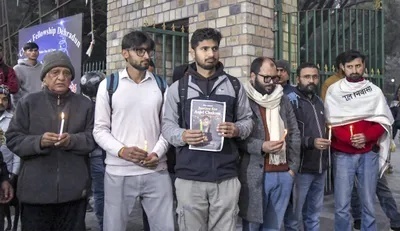
New Delhi: It was among the saddest sights of the year. On a cold, bleak evening on December 31, hundreds of students, mothers, fathers and activists from India’s beautiful northeastern states gathered at Jantar Mantar, in the heart of New Delhi, asking for the same dignity and respect that other citizens of the country consider granted.
They had gathered in protest against the killing of Anjel Chakma, a 24-year-old student from Tripura, who was lynched three weeks ago by a racist mob in Dehradun, Uttarakhand.
The hate crime has drawn widespread condemnation. Political leaders, including leader of the opposition Rahul Gandhi and several chief ministers, have spoken out and called for justice. Notably absent, however, has been any public condemnation from Prime Minister Narendra Modi.
At the gathering, every speaker returned to the same question: how does such violence still happen in a country that claims to be modern, educated and united?
Deputy leader of the opposition in the Lok Sabha, Gaurav Gogoi, who was present at the gathering, said:
“Today, we have to show the entire country that the Northeast is beautiful, proud, united and strong. The message that we want to give is first to the family of Anjel Chakma. We are sorry for what has happened to Anjel and we stand in solidarity with you. Second, we have to send a message to those who have the power to bring justice. Let justice not be delayed. Let the main perpetrator and main culprit be found. Let the courts deliver their justice in a sound and visible manner.”
“It hurts me so much to think about what happened to Anjel,” said Kripa Rani, an animation specialist from Arunachal Pradesh. “Imagine the pain his parents must be going through. Yes, Anjel was from the northeast, from our community – but first and foremost, he was a human being. How can one human being kill another? I just don’t understand.”
Rani reminded of the humiliations that people from the Northeast routinely endure. “We want to tell other Indians that we are just as Indian as you are. Please don’t treat us like this. It hurts when we are called ‘Chinese’ or other names. We want to be able to move around freely, like everyone else, without racist slurs being thrown at us.
“Just because we have smaller eyes does not mean we are from China. We are Indians,” she said.
Calling for stronger protections, she urged the government to pass a law specifically aimed at deterring hate crimes against people from the Northeast.
Pointing to the tricolours in the crowd, Rani further said, “People assume we are somehow less patriotic. But in the northeast, we celebrate Independence Day and Republic Day with immense fervour. If we see the Indian flag lying on the ground, we pick it up respectfully. Don’t question our Indianness.”
“This starts at home. Parents need to teach their children that all people are equal, and that it is wrong to mock or harass someone just because they look different,” she added, reflecting on the prejudice.
Echoing the sentiment, Rulee, a student from Assam pursuing a BA in psychology in Delhi, demanded the need to stop normalising racism.
“So many students from the northeast have been killed because of racism – and this is 2025. Everyone claims to be educated. It’s shameful that we still have to repeatedly say that we are from India. We need to stop normalising this hate. People say, ‘Oh, we were joking.’ But this is not a joke. We’ve been fighting this for a very long time,” she said.
Recalling her first months in the capital, Rulee described a constant sense of unease. “When I first came to Delhi, I noticed the stares. These weren’t stares of curiosity—they made me uncomfortable and made me wonder whether I even belonged here. Near where I live, there’s a school. Children barely in Class 1 or 2 shout ‘chinky Chinese’ at us. Where are they learning this? From parents, neighbours, cousins. That’s where change needs to begin. People need to educate themselves.”
Meanwhile, Ranjunee Chakma, a fashion designer from Mizoram, spoke of the harassment that comes with the discrimination.
“I don’t understand what happens to some Indian men when they see women from the northeast,” she said. “The moment they see well-dressed northeastern girls, their hormones get activated or something. We face constant comments and harassment because of our features. It’s really uncool. We are Indians and we deserve to be treated as such.”
She further pointed to the deep ignorance about the region and asked, “Why aren’t children taught more about the northeast in schools?”
“All I remember learning was that Cherrapunji gets the highest rainfall. That’s it. If students actually learned about the people, cultures, and histories of the northeast, maybe we wouldn’t have to hear things like ‘chinky,’ ‘momo,’ or ‘they eat dogs up there’,” she lamented.
Anjel Chakma’s murder is a grim reminder that racism in India is not abstract or accidental; it is learned, repeated and too often excused.
Until it is confronted – at home, in schools, in politics and in public life – the promise of equal citizenship will remain painfully incomplete for many.
[Rohit Kumar is an educator. Courtesy: The Wire, an Indian nonprofit news and opinion website. It was founded in 2015 by Siddharth Varadarajan, Sidharth Bhatia and M. K. Venu.]