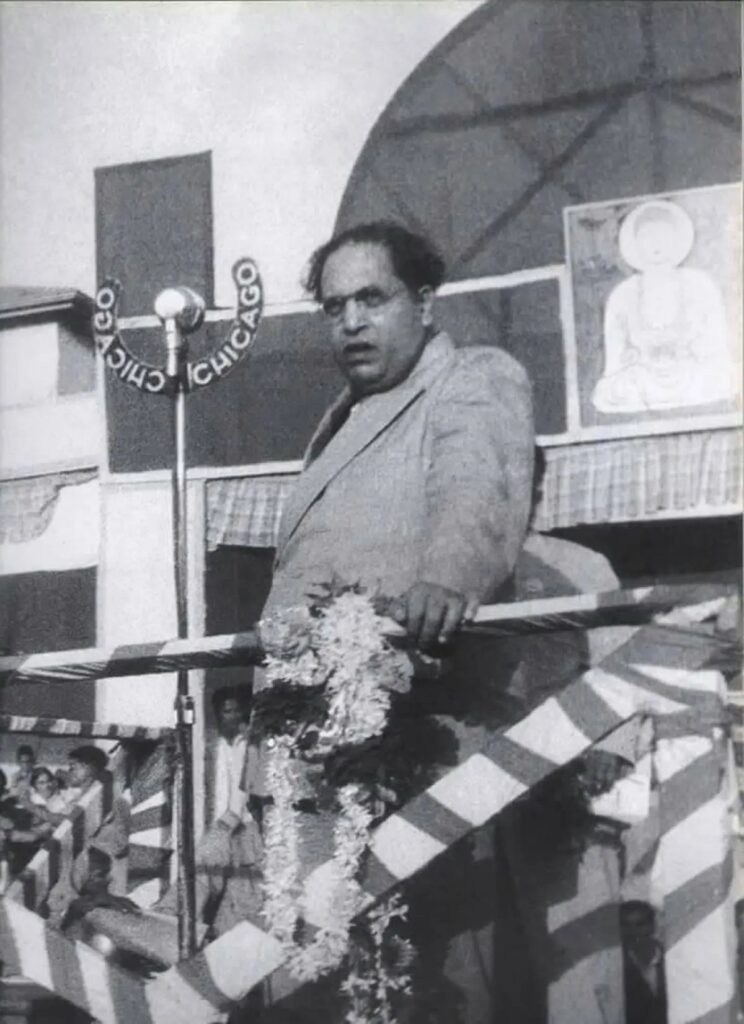
A question haunts every serious student of Indian civilisation: can a tradition that has for millennia sanctioned the humiliation of millions of its own people be reformed from within, or must it be dismantled at its foundations? B.R. Ambedkar—a jurist, scholar, the main architect of the Constitution, and the most unflinching diagnostician of caste India has yet produced—gave a clear and painful answer. Reform is not enough. What is required is a revolution in the very grammar of moral life.
To read Ambedkar philosophically is to encounter a thinker who, far from simply being a protest voice or a Dalit icon, was engaged in something rare and difficult: the construction of a systematic ethics adequate to the specific horrors of the society he inhabited. His project begins with a deceptively simple insistence: that religion must not stand above ethics. Religious doctrines, practices, and the traditions that sustain them must be evaluated, always, by moral standards. If they fail that test, they must yield. This is a demanding philosophical claim about the relationship between religious doctrine/practice and justice.
To appreciate what is philosophically at stake, it helps to trace the distinctions Ambedkar drew with quiet precision. He distinguished, first, between the individual good life and the collective or common good. The great soteriological traditions of India—Upanishadic Hinduism, Buddhism, Jainism—long offered the individual a path towards moksha or nirvana, a release from the cycles of suffering and rebirth. These were genuine spiritual achievements, and Ambedkar did not dismiss them. But a society is not a collection of souls each seeking private liberation. It is a shared enterprise that requires solidarity, cooperation, reciprocity, and above all, equal respect. The collective good cannot be achieved with each person attending to his or her own spiritual pursuits.
Second, Ambedkar drew a sharp distinction between rules of social interaction and moral principles. Social norms—rules of conduct, duties attached to specific communities, regulations governing food, marriage, rituals—may possess social utility or may merely reflect the convenience of those with the power to enforce them. By contrast, moral principles—equality, dignity, fraternity—are universal and possess greater depth. They are not negotiable, not relative to any particular community’s inherited practice. The confusion of social rules with moral principles is, for Ambedkar, one of the deepest intellectual corruptions that Brahmanical Hinduism perpetrated on Indian civilisation.
This brings him to his most searing analytical claim. The Dharmashastric tradition—the body of sacred literature that includes the Manusmriti and its cognates—was not, in any meaningful sense, a religion of principles. It was a religion of rules: rigid, hierarchical, and designed not to express universal values but to maintain a social order in which Brahmins sat at the apex, and those at the base were not merely disadvantaged but profoundly degraded.
The rules governing the lives of the so-called lower castes—what one could eat, whom one could touch, what spaces one could enter—had the force of religious sanction. To violate them was not merely social transgression; it was sacred offence. This, for Ambedkar, was key. When social domination is viewed as sacred, reform becomes virtually impossible from within. The oppressed are told that their humiliation is cosmic, not contingent; eternal, not historical.
The particular horror of untouchability demanded separate analysis, and here Ambedkar’s historical anthropology is perhaps at its most original, even if controversial. Untouchability did not simply arise from being at the bottom rung of the caste ladder. It was, he argued, a distinct phenomenon: the product of a specific history in which marginalised communities, those he called “broken men”, expelled from tribal settlements, were subjected to a religiously inflicted stigma centred on ritual impurity.
The symbolism of the cow as sacred totem was decisive: beef-eating—sometimes out of sheer compulsion, not choice—among these communities became in the Brahmanical imagination not a dietary difference but a sign of permanent defilement. Through this process, a socially contingent exclusion hardened into a hereditary condition, a metaphysics of pollution that placed certain human beings permanently outside the moral community. Ambedkar insisted that race or occupation could not explain untouchability. It was a socio-religious construction, and only by understanding it as such could one begin to dismantle it.
Mistaking a symptom for a cause
A contrast with Gandhi illuminates both figures. Gandhi condemned untouchability with genuine moral feeling, and his concept of the Harijan—the people of God—was intended as an act of revaluation, restoring dignity to those from whom it had been stripped. But Gandhi’s approach remained embedded within a specific Hindu moral world he loved. He believed that the Bhakti tradition, with its radical devotionalism cutting across caste lines, offered resources sufficient for reform from within. Ambedkar’s response was blunt: the structures of Brahmanical authority could not be reformed by appealing to its better angels. The scriptures that sanctified caste oppression were not peripheral to Hinduism; they were, for centuries, its authoritative core. To tinker with attitudes while leaving the textual-institutional infrastructure intact was to mistake a symptom for a cause.
What, then, was Ambedkar’s alternative? His conversion to Buddhism in 1956 was not an act of despair but a result of serious, prolonged philosophical thinking. The Buddha’s teachings offered what the Dharmashastra denied: a tradition committed to reason over scriptural authority, to the cultivation of compassion as a universal obligation, and to a moral community not bounded by birth. Ambedkar was not naive about historical Buddhism’s failures: it had not mounted a decisive challenge to caste in the subcontinent. But he saw in its intellectual architecture the resources for reconstruction. Influenced by the philosopher John Dewey’s pragmatism, he believed that the past was not to be simply recovered but refashioned in the service of present ethical needs. His Navayana—a new Buddhism—was precisely this: an inheritance transformed by the demands of justice.
From all of this emerges a distinctive philosophy of the secular state, one that has not received the attention it deserves in current discussions of Indian constitutional secularism. Secularism in India was conceived not in opposition to religion but to institutionalised religion-related domination. But in recent times, it has had to restrict itself to being only a response to interreligious conflict and domination.
Ambedkar’s obvious and massive contribution—not properly acknowledged in discussions of constitutional secularism—lies in grasping the other equally important dimension of religious domination: the religiously sanctioned intra-religious domination, exclusion, oppression, degradation, and deliberate humiliation of the “lower” castes by the “upper” castes. Given India’s social condition, the state had to act to undermine this grave wrongdoing.
A state committed to freedom, equality, fraternity—values Ambedkar held as sacred, not metaphorically but with genuine philosophical conviction—must actively oppose religious practices such as untouchability that perpetuate intra-religious domination. Caste oppression was not a matter of individual belief to be protected under freedom of conscience. It was a structure of power, encoded in rules of domination and operating through religious legitimation. Our democratic state has both the right to intervene in the caste system and the duty to dismantle it.
What finally emerges from Ambedkar’s work then is a moral vision that the Indian republic has honoured more in constitutional text than in lived reality. He understood that human dignity is not a sentiment but a political achievement—fragile, contested, requiring institutional architecture and perpetual vigilance. To engage with him today is to confront not a distant historical figure but an ever-urgent demand: that we measure our inheritance not by its antiquity but by its justice and that we have the courage to discard what fails that test, however sacred its credentials.
[Rajeev Bhargava, a political theorist, is honorary professor at CSDS, Delhi, and director of the centre’s Parekh Institute of Indian Thought. Courtesy: Frontline magazine, a fortnightly English language magazine published by The Hindu Group of publications headquartered in Chennai, India.]