❈ ❈ ❈
The Adivasi Imprint on the Constitution and the Republic’s Amnesia
Faisal C.K.
Like Shabari in the Ramayana – a forest-dweller who appears only fleetingly yet decisively alters the course of an epic – the role of Adivasi communities in the making of the Indian Constitution has long been treated as marginal, even incidental. Shabari neither commanded armies nor authored grand pronouncements; she merely offered guidance rooted in lived wisdom, quietly steering the protagonists towards a just and transformative alliance. In much the same way, Adivasis – though sparsely represented and rarely foregrounded in nationalist historiography – shaped India’s constitutional imagination through their experience of land, community, and autonomy.
Their imprint survives not in rhetorical flourish but in the Constitution’s deepest structures: its commitment to pluralism, the protection of customary lifeworlds, and the moral recognition that the Republic’s path was charted not only in assembly halls but also from the forests at its margins.
If Shabari’s quiet intervention unsettles the epic’s hierarchy, Professor Nandini Sundar performs a similar corrective in constitutional history. In her evocatively titled essay We Will Teach India Democracy: Indigenous Voices in Constitution Making (2023), Sundar overturns the familiar portrayal of Adivasis as mere beneficiaries of constitutional benevolence and restores them as political educators of the Republic. Drawing upon petitions, mobilisations, and interventions by Adivasi leaders and communities during the late colonial and early constitutional moment, she demonstrates how ideas of collective decision-making, autonomy, and moral restraint on State power travelled upward – from forest societies to the constitutional text – rather than downward from elite assemblies.
Democracy, in this telling, was not a gift bestowed by the nation-state but a lesson insisted upon by those who had long practised it within their own lifeworlds. Like Shabari’s guidance in the Ramayana, these interventions were easy to overlook; yet without them, India’s constitutional democracy would have been thinner, more majoritarian, and far less humane.
‘The most democratic people on the earth’
Jaipal Singh Munda, a versatile genius and Marang Gomke (Supreme Leader) of the Adibasi Mahasabha who later became a prominent member of the Constituent Assembly, articulated this moral claim with striking clarity. In his presidential address to the Sabha on 21 January 1939, he asserted: “The Adibasis are the ancient aristocracy of India […] The Adibasis solved the problem of democracy, marriage laws, equality of the sexes, village government and simple living long ago. Their sense of private and public morality is very high. Although the Adibasis are very poor, their general intelligence is fairly high”.
The Mundas of Jharkhand, he reminded the nation, practised collective ownership of land – unlike the so-called advanced peoples. Jaipal Singh and his organisation aligned themselves firmly with the Indian National Congress and its goal of independence, but the Congress, in turn, remained largely lukewarm towards the Adivasi movement.
In the Constituent Assembly, Jaipal Singh represented what he called the “Never United and Scattered Adivasis” of India. It was he who single-handedly pressed for constitutional reservations for the Scheduled Castes and Scheduled Tribes. Speaking on 19 December 1946, he declared with unmistakable force: “If there is any group of Indian people that has been shabbily treated it is my people. They have been disgracefully treated and neglected for the last 6000 years. The history of the Indus Valley civilisation, a child of which I am, shows quite clearly that it is the new comers – most of you here are intruders as far as I concerned – it is the new comers who have driven away my people from the Indus Valley to the jungle fastness. This Resolution is not going to teach Adibasis democracy. You cannot teach democracy to the tribal people; you have to learn democratic ways from them. They are the most democratic people on the earth [….] There is no question of caste in my society. We are all equal”.
He drew attention to the existence of historical tribal republics in India, citing Jawaharlal Nehru’s The Discovery of India. Jaipal Singh also consistently advocated women’s representation and gender equality, protesting the complete absence of tribal women from the Advisory Committee on Fundamental Rights, Minorities, and Tribal and Excluded Areas constituted by the Assembly.
Voices from India’s far east
Jaipal Singh was not alone. Five other tribal members – Dharanidhar Basumatary, Boniface Lakra, J.J.M. Nichols Roy, Devendranath Samanta, and Dambar Singh Gurung – sat in the Constituent Assembly. More significantly, constitutional debates travelled far beyond Delhi, permeating grassroots political life in the tribal regions of the Northeast.
By April 1947, the Garo Hills of present-day Meghalaya had become a hive of constitutional deliberation. An elected Garo Hills National Conference was convened at Tura, where delegates asserted Garo autonomy within the broader framework of Assam and India. Their five-page Proposed Constitution of the Garo Hills Union envisioned a participatory, consensus-based democracy. It proposed a three-tier federation guaranteeing maximum autonomy to the Garo Hills Union and recommended women’s reservation as well as a collaborative executive structure, whereby the runner-up in the presidential election would serve as vice-president. The draft guaranteed freedom of religion and, remarkably for its time, even proposed the abolition of the death penalty.
Between 1946 and 1947, other tribal communities across the Northeast – including the Mizo and the Khasi – produced similar constitutional drafts rooted in consultation, autonomy, and restraint of power.
Yet official statistics leave little doubt that India’s Adivasi communities today remain among the most impoverished and deprived sections of the population. Despite constitutional guarantees, Scheduled Tribes consistently lag behind national averages on core human-development indicators. Literacy among STs stands at around 59%, far below the national average of 73%. Nearly 41% of Adivasi children under five are stunted, and over 39% are underweight. Infant mortality among STs significantly exceeds the all-India figure, while anaemia afflicts more than two-thirds of Adivasi children and nearly 65% of women.
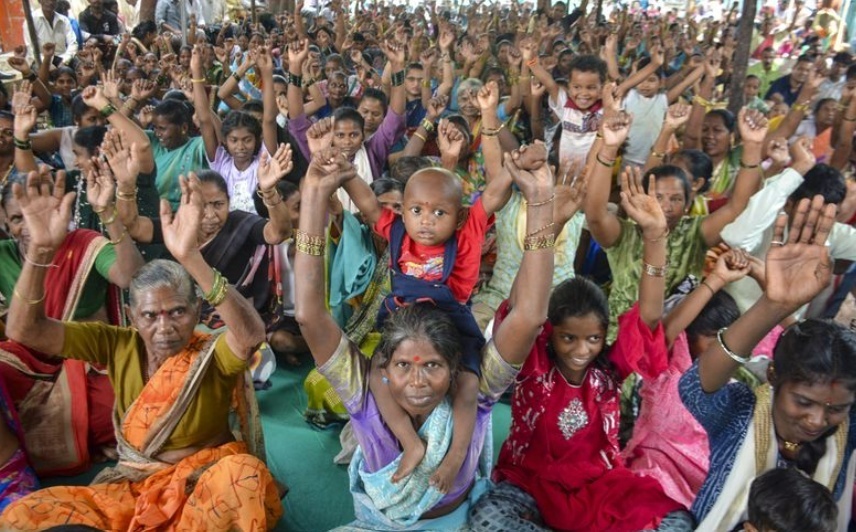
Poverty for Adivasis, therefore, is not merely a matter of low income. It manifests as chronic nutritional insecurity, educational exclusion, poor health outcomes, and fragile access to basic services. This structural deprivation is further exacerbated in conflict-affected tribal belts, where Maoist insurgency and counter-insurgency operations have turned everyday life into a zone of fear – disrupting schools and healthcare, hollowing out local governance, and rendering Adivasis collateral victims in a violent contest between the State and armed groups. The paradox is stark: communities that helped shape the Constitution’s most humane provisions continue to inhabit the margins of the Republic it founded.
“The whole history of my people is one of continuous exploitation and dispossession by the non-aboriginals of India punctuated by rebellions and disorder, and yet I take Pandit Jawahar Lal Nehru at his word. I take you all at your word that now we are going to start a new chapter, a new chapter of Independent India where there is equality of opportunity, where no one would be neglected,” Jaipal Singh voiced this ebullient hope in his Constituent Assembly speech of December 19, 1946.
As the Republic now turns 77, it is time for sober introspection. Why do the hopes and aspirations of India’s aboriginal peoples – the most marginalised and deprived – still remain a distant mirage? Has the Constitution failed India’s aboriginals, or was the faith of their forefathers tragically misplaced?
[Faisal C.K. is Deputy Law Secretary to the Government of Kerala and author of The Supreme Codex: A Citizen’s Anxieties and Aspirations on the Indian Constitution. Courtesy: The Wire, an Indian nonprofit news and opinion website. It was founded in 2015 by Siddharth Varadarajan, Sidharth Bhatia and M. K. Venu.]
❈ ❈ ❈
Why Self-Rule Still Matters in India’s Tribal Homelands
C.R. Bijoy
Heightened political activity around the demand for Sixth Schedule status under Article 244(2) has sprung up in a number of regions across the country in recent months. Nationally, Ladakh is the most visible of them all since the violence and killings in September. The Ladakhis, having intensified their struggle, submitted their proposals for Sixth Schedule status and statehood under Article 371 in November 2025. The autonomous hill councils in Leh and Kargil, created through an enactment of the erstwhile Jammu and Kashmir government, and the Union Territory status since October 2019 have failed to fulfil their democratic aspirations for self-governance.
The Sonowal Kachari, Deori and Thengal communities in Assam, and the Darjeeling Hills of West Bengal, which have Autonomous Councils with limited powers like Ladakh under state laws, have also demanded Sixth Schedule status. So too have the Naga and Kuki-Zo of Manipur. The Sixth Schedule demand has now reached the central Indian tribal belt, specifically Bastar, Chhattisgarh, a Fifth Schedule region under Article 244(1). The Provisions of the Panchayats (Extension to the Scheduled Areas) Act, 1996 (PESA) – the village self-rule law – already applies there.
On February 5, 2026, the Union government, the Nagaland government and the Eastern Nagaland People’s Organisation signed a proposal for the Frontier Nagaland Territorial Authority (FNTA), covering six eastern districts of Nagaland, with legislative powers over 46 state subjects and greater powers than those under the Sixth Schedule. This was despite Nagaland’s special status under Article 371A, which gives the state assembly exclusive powers over matters concerning religious or social practices, customary law and procedure of the concerned communities, and the administration of civil and criminal justice in areas covered by customary law. It also provides that no Union law relating to ownership and transfer of land and its resources shall apply unless the state assembly resolves to do so.
Scheduled areas
About 13% of the country is designated as Scheduled Area – 11.3% under the Fifth Schedule and 1.7% under the Sixth Schedule. Around 6.3% of India’s population, as per the 2011 Census, both tribes and non-tribes, reside in these areas – 5.7% in the Fifth Schedule areas and 0.6% in the Sixth Schedule areas. Of the total Scheduled Tribe population, 39.4% live in Scheduled Areas – 35.2% in the Fifth Schedule areas and 4.2% in the Sixth Schedule areas. These areas are tribal-preponderant, with Scheduled Tribes constituting about 53% of the population in Fifth Schedule areas and 60% in Sixth Schedule areas.
The Fifth Schedule
The Fifth Schedule areas are notified in parts of ten states – Andhra Pradesh, Telangana, Odisha, Jharkhand, Chhattisgarh, Madhya Pradesh, Rajasthan, Gujarat, Maharashtra and Himachal Pradesh. The Kerala government proposal in 2015 to notify 2,133 habitations, five Gram Panchayats and two wards in five districts as Scheduled Area awaits Union government approval for Presidential notification.
In the notified areas, the Governors of these states have not used their extraordinary powers under Article 244 to prevent or modify the application of any law made by parliament or the state legislature to the Scheduled Areas. Nor have they done so to notify regulations for peace and good governance.
Following the 73rd Amendment to the constitution, PESA, enacted by parliament, was incorporated into state panchayati raj laws between 1997 and 2001 – Maharashtra and Odisha in 1997; undivided Andhra Pradesh, Himachal Pradesh, Gujarat, Madhya Pradesh and Chhattisgarh in 1998; Rajasthan in 1999; and Jharkhand in 2001.
Popularly known as village self-rule, the rules to operationalise PESA were notified much later – Andhra Pradesh, Himachal Pradesh and Rajasthan in 2011; Maharashtra and Telangana, adopting the Andhra Pradesh PESA Rules of 2011, in 2014; Gujarat in 2017; Madhya Pradesh and Chhattisgarh in 2022; and Jharkhand in 2025. Odisha is yet to notify PESA rules.
The hamlet-level Gram Sabhas are empowered to manage natural resources, prevent land alienation, preserve cultural traditions and govern according to customary laws, ensuring autonomy. As village self-rule is impossible without autonomy at higher levels, PESA mandated that these structures be patterned on the Sixth Schedule. Importantly, they are not to encroach upon the powers of the Gram Sabha. Steeped in feudal and colonial legacies, state governments did not comply with this ‘outrageous’ democratic core of PESA, which represents a vital Adivasi inheritance.
The PESA framework was further elaborated in the Forest Rights Act, 2006, extending its scope beyond Scheduled Areas to cover forested regions across the country.
The Sixth Schedule
Ten Sixth Schedule areas have been notified in four states: North Cachar Hills (1951), Karbi Anglong (1952) and Bodoland Territorial Council (2003) in Assam; Khasi Hills (1972), Jaintia Hills (1972) and Garo Hills (1973) in Meghalaya; Mara, Chakma and Lai (1987) in Mizoram; and Tripura Tribal Areas (1982) in Tripura.
The elected Autonomous District and Regional Councils in these areas have legislative powers over land management, forests other than reserved forests, inheritance, marriage, social customs and village administration. The councils also have judicial powers to constitute village courts to hear cases between Scheduled Tribes and administrative and financial powers relating to primary education, health and the collection of specific local taxes.
Political demands for Sixth Schedule status have also resulted in the creation of Autonomous Councils patterned on the Sixth Schedule, with subjects devolved to them through state enactments. Fifteen Autonomous Councils were created: the Rabha Hasing (1995), Mising (1995), Lalung (Tiwa) (1995), Sonowal Kachari (2005), Deori (2005) and Thengal Kachari (2005) in Assam; Senapati, Sadar Hills, Ukhrul, Chandel, Churachandpur and Tamenglong autonomous councils in Manipur under the Manipur (Hills Areas) District Council Act, 1971; Leh (1995) and Kargil (2003) in Ladakh; and the Gorkhaland Territorial Administration in West Bengal (2012).
Unlike Sixth Schedule areas, these Councils lack legislative and judicial powers and have limited administrative, executive and financial autonomy.
The politics of scheduling
The discourse on scheduling emerged within the colonial state’s bureaucratic apparatus, among anthropologists and nationalists, when the transition from a subjugated colonial enterprise to a democratic republic was imagined, construed, fought for and constructed. Powerful forces with diverse political demands arose across different geographies and communities, contesting the nature of the democracy and governance that India should embody.
The story of how feudal, mercantile and capitalist forces converged with the masses into a nationalist upsurge that forced the war-devastated British Empire to withdraw is well known. Far less attention has been paid to the parallel debates on scheduling and the place of Adivasi homelands in the emerging republic.
The Adivasis too rose, making their indelible mark on the freedom struggle and on what later coalesced as the constitution. Their political claims found constitutional expression in the scheduling provisions. Article 244 stands out as a provision of particular importance to the Scheduled Tribes and their largely mountainous and forested homelands.
The tribals continue to use the scheduling provisions under Article 244 to develop powerful instruments of democracy and governance, radically different in structure and substance from the electoral democracy embedded within feudal and colonial constructs that mainstream India knows. The contentions and perceptions of over a century ago continue to resonate today, as powerfully as ever.
The colonial administration did not extend its reach to inaccessible mountainous and forested areas that were agriculturally backward, sparsely populated and had low literacy levels. The financial liability involved in governing these areas, coupled with their low revenue potential, prompted it to assign revenue collection where possible to the zamindars, who could also exercise police and magisterial powers. Tribals inhabited some of these areas, largely free from levies because of their limited economic potential.
A complex framework of ‘general regulations’, laws and Acts was used to progressively tighten the British East India Company’s rule and administration. These early foundational laws, enacted by the Governor-General-in-Council in Bengal, Madras and Bombay, governed their territories before comprehensive legislative Acts passed by the British parliament became the norm.
Scheduled districts
While deregulated areas emerged during the 1930s and 1940s to keep them outside the statutes in force elsewhere, after the Rebellion of 1857 against the East India Company, the British Crown took sovereign control of India through the Government of India Act, 1858. The Scheduled Districts Act, 1874, followed. It repealed earlier Acts exempting General Regulations and notified Scheduled Districts, including areas where the local government could apply specific laws when authorised by the Governor-General-in-Council.
Scheduled Districts were notified in the then Madras, Bombay, Bengal, North-Western Provinces, Punjab and Central Provinces, and in areas under the chief commissionerships of Assam, Coorg, Andaman and Nicobar Islands, Ajmer and Merwara, the Hill Tracts of Arakan and the Pargana of Manpur. Only parts of these areas were predominantly inhabited by ‘aboriginals’, as tribals were officially labelled at the time.
Backward tracts
Devolution of power to the Indian political class and the Indianisation of the civil service began in the early 1900s. With the rise of Indian nationalism and demands for self-rule, the British parliament enacted the Government of India Act, 1919 to introduce a more inclusive system of governance. It introduced dyarchy, transferring certain subjects to elected provincial legislative councils while reserving others for the British Governors under the Viceroy-headed central government.
The 1919 Act consolidated the Scheduled Districts as ‘Backward Tracts’, and empowered the Governor-General-in-Council to determine whether Acts of the legislature should apply to them, and if so, with what exceptions or modifications.
The Government of India Act, 1935 introduced excluded and partially excluded areas. No Act of the federal or provincial legislature was to apply to an ‘Excluded’ or ‘Partially Excluded’ area unless the Governor so directed. The Governor could also issue regulations for peace and good governance. The final Order-in-Council notified eight areas as excluded and twenty-eight as partially excluded, expanding the extent of homogeneous aboriginal-majority areas as per the 1931 Census.
Thus emerged the contours of scheduling – the demarcation of tribal-preponderant areas and their governance – the precursor to the fifth and sixth schedules. The 1935 Act also incorporated ‘separate electorates’ for Muslims, Sikhs, Indian Christians and Anglo-Indians, and ‘reserved seats’ for the Depressed Classes – though not for tribals.
The Government of India (Excluded and Partially Excluded Areas) Order, 1936, which came into force in April 1937, classified Laccadive Islands including Minicoy and Amindivi Islands (Madras); the Chittagong Hill Tracts (Bengal); Spiti and Lahul in Kangra District (Punjab); the North-East Frontier Tracts of Sadiya, Balipara and Lakhimpur, the Naga Hills District, the Lushai Hills District and the North Cachar Hills Subdivision of Cachar District (Assam); and Upper Tanawal in Hazara District (North-West Frontier Province) as excluded areas.
Madras Agency areas; parts of West Khandesh, East Khandesh, Nasik, Thana and Panch Mahal Districts (Bombay); Darjeeling District and parts of Mymensingh District (Bengal); parts of Dehra Dun and Mirzapur Districts (United Provinces); Chotanagpur and Santal Parganas (Bihar and Orissa); Mandala District and parts of Chanda, Chhindwara, Bilaspur, Durg, Balaghat, Amraoti and Betul Districts (Central Provinces and Berar); Angul and Sambalpur Districts and Ganjam Agency Tracts (Orissa); and the Mikir, Garo, Khasi and Jaintia Hills, except Shillong (Assam), were classified as partially excluded areas.
Though not a central issue, the place of the aboriginal and hill tribals in the emerging political and administrative arrangement came to the fore. Prominent among those who influenced this discourse were anthropologists turned administrators such as J.H. Hutton, J.P. Mills, W.G. Archer and W.V. Grigson; non-officials such as Verrier Elwin and Christoph von Furer-Haimendorf; and nationalists such as A.V. Thakkar and G.S. Ghurye.
For the anthropologist-administrators, the tribes were an administrative problem. They remained outside mainstream society, especially its caste order. Their self-reliant, communitarian and nature-dependent way of life had evolved well-established democratic traditions and governance institutions in contrast to caste society. Modern governance, shaped by statutory law, the electoral process and organised religion, was seen as antithetical to the self-governing tribal societies.
Mostly educationally disadvantaged, they were considered unlikely to navigate the labyrinthine administrative and judicial system in the foreseeable future. Moreover, dominant Indian society had not demonstrated an ability to administer the tribals benevolently. Politicians could not be trusted to represent tribal interests. The tribals would, at best, be assimilated into the depressed classes, facing systemic discrimination, exclusion and denial of rights.
Nevertheless, steady incursions by exploitative non-tribal outsiders into their homelands had further marginalised the tribals through land alienation and debt bondage. Their anger periodically erupted in revolt. The onus of civilising and protecting them, it was argued, lay with the British parliament. Hence came the policy of excluding or partially excluding tribal-majority areas from the legislative powers of elected assemblies – the strategy of ‘isolate and protect’.
The nationalists preferred intervention and rapid assimilation into the mainstream of Adivasis – as intermediate castes rather than as part of the depressed classes. They saw the aboriginals as an integral part, though neglected and exploited, of the wider mosaic of Hindu society. Their exclusion from the democratic process, it was argued, would only deepen their backwardness. The colonial capture and exploitation of forest lands had already provoked numerous rebellions. Territorial segregation, viewed as an instrument of British divide-and-rule and a remnant of paternal despotism, needed to be firmly rejected.
Consequently, the position on the tribal question came to be framed as ‘isolationist’ versus ‘assimilationist’. The tribals, however, saw ‘exclusion’ as recognition of their relatively autonomous status as self-governing entities ranging from complete freedom to degrees of local autonomy. ‘Assimilation’, to the tribals, implied serfdom and the loss of their institutions, identity, land and natural resources – the causes of their further marginalisation and alienation.
The shifting official nomenclature reflected changing political understandings of tribal identity and their place in the emerging nation-state. The ‘aboriginals’ were successively termed ‘hill tribes’, ‘tribes’ and finally ‘Scheduled Tribes’ in the constitution. They were officially classified as ‘animists’ in the 1921 Census and as following ‘tribal religion’ in the 1931 Census, even as the number identifying with other religions, particularly Hinduism, increased significantly, a shift attributed to the influence of the Sudhi campaign, part of a broader phase of communal consolidation in the late nationalist movement.
Many localised tribal movements against British colonial rule and exploitation by outsiders, known as ‘dikus’, moneylenders and landlords, centred on protecting land, forests and cultural autonomy. They eventually merged with the national movement. There were also communist-led militant struggles: the Warli Revolt in Thane (Bombay) in 1945 against landlords, moneylenders and forced unpaid labour or begar; the Tebhaga movement in Bengal in 1946-47; the Telangana Rebellion from 1946 to 1951 against the princely state of Hyderabad; and the Orissa peasant movement in 1946 demanding abolition of the zamindari system, reduction of rents and illegal taxes, debt relief and an end to begar.
Jaipal Singh Munda, leader of the Adivasi Mahasabha, demanded statehood for Jharkhand. In the Constituent Assembly, he represented Adivasi demands with valour and authenticity.
Tribal uprisings in the North East differed from agrarian or forest-based struggles and were directed towards political autonomy or complete independence from British rule. These included the Naga struggle for self-determination and declaration of independence, the Reang revolt against increased house taxes imposed under British influence and the influx of outsiders into traditional lands, and the Hajong unrest in the Garo Hills against local exploitation. These movements, each a resistance to colonial and local injustices, focused on preserving traditional governance as well.
These upsurges had little impact on the politics of scheduling or the making of the constitution. Nor did the reports of the Sub-Committee on the North East Frontier (Assam) Tribal and Excluded Areas and the Sub-Committee on Excluded and Partially Excluded Areas (Other than Assam), submitted in 1947. The outcome for the tribal population was largely continuity with the Government of India Act, 1935, with minor modifications, such as the ‘reserved seats’ introduced for Scheduled Tribes alongside Scheduled Castes, and more recently for women, under the constitution.
After 1950, sustained struggles by the tribals carried forward the politics of scheduling. The fifth and sixth schedules enabled distinct forms of governance, extending beyond Scheduled Areas into other forested regions. These were not concessions of the ruling class, but were fought for and secured.
The Ministry of Panchayat Raj proposal in 2010 to amend the constitution to restructure local governance nation-wide and expand autonomy, integrating elements of the fifth and sixth schedules, has yet to trigger a democratic upsurge. The larger question of how this might reshape democratic practice beyond tribal homelands therefore remains unexplored.
[C.R. Bijoy examines natural resource conflicts and governance issues. Courtesy: The Wire, an Indian nonprofit news and opinion website. It was founded in 2015 by Siddharth Varadarajan, Sidharth Bhatia and M. K. Venu.]