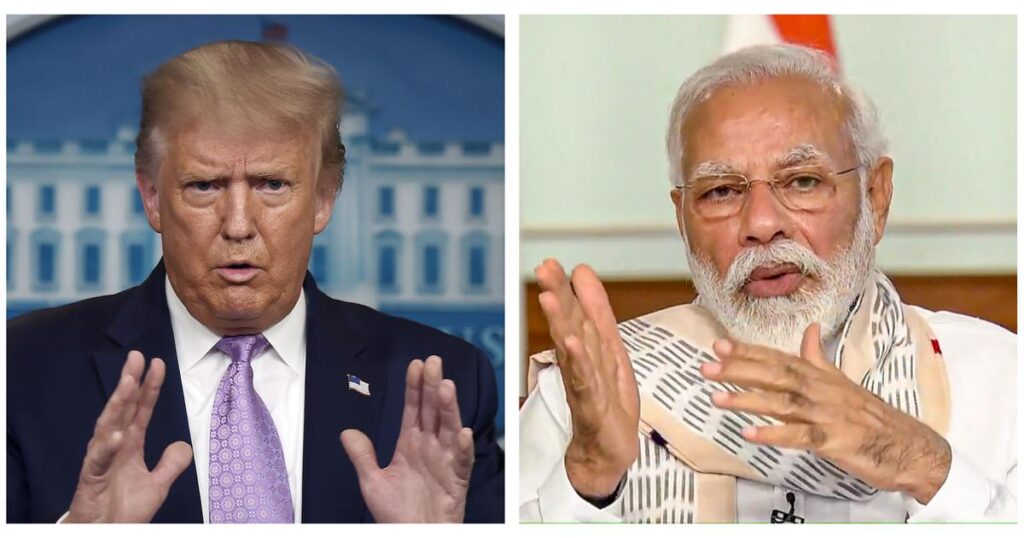
Many Indians are never tired of telling others that theirs is the largest democracy in the world, just as many Americans, at least until very recently, would tell you that theirs is the ‘greatest’ democracy. There is considerable doubt now if either country can be called a democracy.
Much, of course, depends on what you mean by democracy. Even among democracy theorists there is a dispute about definitions. For example, for theorists like Robert Dahl or Adam Przeworski, as long as there are contested elections, and there is a chance of the incumbent losing and having lost, of accepting the electoral defeat, the country is definitely a democracy. For other theorists what happens in between elections, particularly on vital matters like freedom of expression and rights of minorities and dissenters, determines if a country is democratic or not.
By the first criteria it is arguable that the US is still a democracy, although elections have long been seriously circumscribed by widespread gerrymandering of electoral constituencies and by the role of big money in election funding that makes barriers to entry for neophytes rather high; and in spite of Trump’s atrocious denial of defeat in 2020, he after all left the White House at that time to come back to a more decisive victory in 2024. In India the electoral picture in recent years has become much murkier, as the corporate donations to election funding are now grossly disproportionate in favor of the current incumbent, the media are largely captured by the latter, and the appointment procedures at the Election Commission are now distorted enough to raise serious questions about its independence or impartiality—the electoral playing field is thus highly uneven and often uncompetitive, even though some of the contests remain vigorous.
By the second criteria of democracy involving civil and political rights, it is now in much greater danger in both countries. In this respect erosion of democratic institutions in India has been continuing for several decades, but it got accelerated since 2014, when a political party (BJP), linked with a militant cultural organization (RSS), whose ideology can be described as one of Hindu-supremacist authoritarianism, came to power.
But in recent months the speed of decline in democracy has been much faster in the US. In an essay in the New York Times (May 8, 2025) the political scientists, Steven Levitsky, and Daniel Ziblatt (both of Harvard University) and Lucan Way (of University of Toronto) have given their judgment that the US has already crossed the red line to move to undemocratic territory. This red line is defined by them in terms of the cost of opposing the government. They believe that the Trump administration’s weaponization of government agencies and flurry of punitive actions against critics and perceived opponents have raised the cost of opposition to an extent that definitely belongs to undemocratic regimes. This has, of course, happened in India in similarly nefarious ways, though over a few years. In both cases the extreme right-wing has learned that a succession of outrageous actions—what Trump supporters call ‘flooding the zone’—energize their militant support base, keep the opposition in startled paralysis, and slowly inures the general public who after a point develops a sort of ‘outrage fatigue’.
Meanwhile an atmosphere of fear and official retribution and realization of the difficulties of collective action make organized resistance a long shot. Even moderate Republicans have received death threats from pro-Trump vigilantes. Some judges who gave their verdicts opposing the procedures of Trump deportations have received unwanted pizza deliveries at home, with the implicit message: “we know where you live”. Vigilante justice and lynchings by mobs of ruling party supporters have become part of the new normal in India. The other day a friend in India ironically said to me: “Please don’t tell Trump about our ‘bulldozer babas’ (the officials and political leaders who bulldoze the houses of minorities and other perceived enemies as a form of collective punishment at the slightest pretext in lawless abandon); he may not yet be aware of this potential weapon of silencing his opposition”. In this sense thugocracy is much more advanced in India.
In the face of all this the old liberal checks and balances and separation of powers are much too weak; in particular, the dominated legislature provides hardly any check on the overbearing executive. The courts offer some (often feeble) opposition, but there is always the matter of judicial credibility ultimately hanging by a thin thread, if the executive just decides not to implement the court verdict. Indian judicial history is littered with unenforced court judgments. In the US Trump administration has shown some early signs of defiance; in a widely noted podcast interview the current Vice President had quoted President Andrew Jackson, reportedly saying “The chief justice has made his ruling. Now let him enforce it”. There is also a measurable difference in the structure of the Supreme Court in the two countries. In the US Supreme Court judges usually enjoy life tenure that gives them some potential of independence. In India the average tenure of a Supreme Court judge is about 5 years (that for the Chief Justice is only about 1.5 years), with 65 being the retirement age. The lure of post-retirement plum official jobs in India further weakens the incentives for judicial independence.
There is as yet a substantial difference between the two countries in the behavior of the media as a watchdog. In the US some of the main media (both print and electronic) have continued to show defiant independence, though already in some cases there have been instances of capitulation on the part of media owned by business conglomerates (CBS News, Washington Post, etc.). In India most of the mainstream media have displayed spinelessness, if not outright cheer-leading for the government. The way Trump is mercilessly mocked every night in late-night TV in the US is simply unthinkable in India. Cartoonists and comedians have been persecuted in India for much weaker fare. Arrests of journalists, social workers and academics on flimsy grounds have become routine. Habeas corpus is often in abeyance.
The intelligentsia in universities can provide some leadership in liberal opposition. The current regime in India, following the cultural agenda of its parent organization RSS, has been active right from the beginning in decimating this potential opposition, by manipulating appointments in university administration and faculty and utilizing for this purpose its hold over finance in the universities which are still largely public. But even in private universities the business donors and trustees have been active in smothering cases of independent political voice. In the US some of the best universities in the world are well-endowed with private money which gives them some buffer. Trump’s assault on them and on scientific research in general have astonished the whole world, as a paroxysm of American self-harm in the MAGA (Make America Great Again) cause. After a few cases of initial capitulation there are now some signs of resistance on the part of the universities.
Despite proclamations of the close association between capitalism and democracy in the popular rhetoric, the rapidity with which businesses fall in line in authoritarian countries has been remarkable, from Nazi Germany to today’s US and India. While both India and the US can be described as crony oligarchies, the brazenness with which the world’s richest man has trampled on the various agencies of the state in the US (meanwhile being the beneficiary of about $40 billion in federal contracts) outdoes by some measure all the backdoor crony deals between the Indian state and the business houses of the Adanis and the Ambanis that the opposition in India has (justifiably) complained about. One should, however, point out that so far at least the Trump administration has remained persistent in pursuing antitrust legal cases against tech giants like Meta and Alphabet—it is unthinkable for Indian authorities to pursue similar anti-monopoly measures against the large conglomerates that dominate the corporate economy in India.
One difference in the two crony oligarchies is that unlike in India the top leader in the US and his family are quite shameless in abusing their power in various kleptocratic business deals for family enrichment.
Finally, the very transactional nature of all Trump policies brings to light another big difference with the Indian ruling party. Despite anti-‘woke’ pretensions Trump really does not have any ideology; all he cares for is ‘deals’ (usually greasy ones) and some self-infatuated glory. In contrast the authoritarian project of the RSS-BJP in India is largely about ideology, albeit a rather poisonous one, that of establishing a Hindu-supremacist state (replacing the pre-existing pluralistic constitutional order) that hatefully consigns most religious minorities (particularly the Muslims) to a second-class citizen status. The US being a superpower, Trump policies will have pernicious international consequences (like upending the global economic order and environmental agreements), but within the US their transactional nature may not make the domestic damage durable, particularly if the likely resilience of American civil and political institutions holds. But within India these institutions, already weak, are crumbling, and the polity and society will take a long time to recover from the RSS-BJP onslaught. In that sense the latter authoritarian project is more sinister.
[Pranab Bardhan is an Emeritus Professor at Berkeley, USA.]