A Brief History of India’s Education System
Part 6: Is the Government Really So Poor That it Can’t Provide Education to All Our Children?
[This article is a part of a series of articles on ‘India’s Education Journey: From Macaulay to NEP’. This is the eleventh part of this series. The previous articles have been published in previous issues of Janata Weekly.]
Most developed countries have a very elaborate social security network for their citizens, including unemployment allowance, universal health coverage, free school education, free or subsidised university education, old age pension, maternity benefits, disability benefits, family support such as child care allowance, financial assistance for those too poor to make a living, and much more. Governments in these countries spend substantial sums for providing these social services to their people.
The Modi Government claims that India is one of the world’s fastest growing economies and envisions India becoming a developed country by 2047. Whatever be the truth in these claims, at the very least, India’s social sector expenditures should be comparable with those countries at a similar level of development. But a RBI report admits,
In terms of GDP, the social sector expenditure, primarily constituting health and education in India continues to remain woefully below peers. [1]
While the average public expenditure on social services in the OECD countries has remained around 21 percent of GDP for the last many years, and for the EU–27 has been even higher at nearly 32 percent of GDP, India’s social service expenditure (Centre and States combined) is less than 8 percent of GDP (see Chart 6.1). Since the per capita GDP of the developed countries is much more than that of India, their per person social sector spending is several times higher than what these percentages suggest.
Chart 6.1: Social Sector Expenditure as % of GDP, 2022
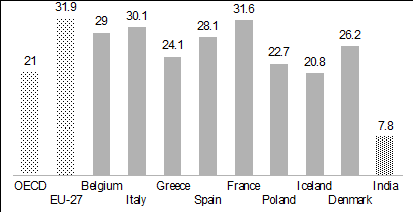
Source: for OECD: “Social Spending”, https://data.oecd.org; for EU: Government Expenditure by Function – COFOG, https://ec.europa.eu; for India: Economic Survey, 2023–24.
As a result of this low spending, India’s welfare services—from health to nutrition to pensions—are in a dismal state[2]:
- India’s public health spending is among the lowest in the world—it ranks 179 out of 189 countries.[3] Because of this, India is facing a ‘health emergency’: it is estimated that about 24 lakh people die each year from treatable diseases because of lack of affordable, good quality public health services.[4]
- A ‘hunger and malnutrition emergency’ grips the country: according to the 2024 State of Food Security and Nutrition in the World (SOFI) report published jointly by five UN organisations, about 58.9 crore people—41.9 percent of India’s population—suffered from moderate or severe food insecurity during 2021–23.[5] Yet, the government has slashed food subsidy spending by nearly 75 percent (as a share of the budget) over the past five years (2020–21 to 2025–26). Instead of providing foodgrains to the poor at subsidised rates, it is more interested in providing subsidised foodgrains to companies making biofuels for luxury vehicles.
- Our ruling regime is totally insensitive towards the 5 crore children in the country who are malnourished and the over 2 crore pregnant women and lactating mothers, majority of whom are suffering from anaemia. It has cut the budget for the important Anganwadi programme—meant to provide supplementary nutrition to these groups—by 33 percent over the past decade. Nearly 75 percent of pregnant women are even being denied the paltry financial assistance promised to them under the NFSA—meant to partially compensate them for wage loss so that women can take adequate rest before and after delivery.
- There are nearly 15 crore people in India above the age of 60. Most of them worked for low wages in the informal sector and have no savings to support a dignified life in their old age. The least the government can do is give the elderly a decent pension. But the Modi Government’s allocations for pension schemes are scandalously low. The Indira Gandhi National Old Age Pension Scheme offers just Rs. 200 per month (Rs. 500 per month for those aged 80 years and above)—an insultingly meagre amount.
Why are Social Sector Expenditures So Low?
The reason for these abysmally low welfare expenditures is—the Modi Government has been doling out massive ‘subsidies’ to the big corporate houses and the rich, to the tune of several lakh crore rupees every year. These breathtaking giveaways are cleverly disguised as ‘incentives’ for economic growth. Meanwhile, when it comes to funding essential welfare schemes that provide the bare essentials of life to the poor, the government pleads a lack of resources. To justify the cuts made in social sector expenditures, they are derided as ‘wasteful’, ‘inefficient’ and encouraging ‘parasitism’.
Here is a snapshot of some of the subsidies being given to the rich:
i. Tax Cuts and Concessions to the Rich
The Modi Government has sharply reduced corporate tax rates. In September 2019, the base corporate tax rate was reduced from 30 percent to 22 percent, and for new manufacturing companies from 25 percent to 15 percent—making India’s corporate tax rates among the lowest in the world. The Finance Minister admitted that this would cost the exchequer Rs. 1.45 lakh crore every year.
India has no wealth tax. India also has almost zero property tax.
Apart from low tax rates, the government has also been giving tax exemptions to the rich—in corporate taxes, income taxes and excise duties—to the tune of several lakh crore rupees every year. An analysis of Union Budget documents reveals that the total tax concessions to the corporate houses and the ultra-rich during the past decade (2014–15 to 2023–24) work out to around Rs. 55 lakh crore.[6]
This is a mind-boggling sum—it is more than the Union Budget for 2025–26 (Rs. 50.6 lakh crore)!
ii. Loan Write-Offs
During the first ten years of the Modi Government (2014–15 to 2023–24), public sector banks wrote off loans totalling Rs. 11.57 lakh crore. After deducting recoveries, the amount permanently waived stands at Rs. 9.60 lakh crore—money that will never be recovered. This figure excludes accrued interest; if that were included, the total loss could be up to four times higher.
Even after these massive write-offs and waivers, public sector banks still had Rs. 3.36 lakh crore in bad loans (non-performing assets or NPAs) as of June 2024. Given the government’s track record, most of these are also likely to be eventually waived.
But this is just the visible part of the story. Additionally, public sector banks have restructured loans of the super-rich—a roundabout way of writing off loans. While exact figures are unavailable, these too are likely to amount to several lakh crore rupees.
Even if we make a conservative addition of the above amounts, the total loan waivers (official and disguised) over the decade 2014–15 to 2023–24 should be of the order of Rs. 20–25 lakh crore.[7] Including interest, the real figure could be two to four times higher.
iii. Transfer of Public Wealth to the Private Sector
The Modi Government has handed over control of the country’s mineral wealth and resources to private corporations in return for negligible royalty payments; transferred ownership of profitable public sector corporations to foreign and Indian private business houses at throwaway prices; handed over control of infrastructure including airports, ports, telecom network, etc. to its corporate friends at hugely discounted prices; given direct subsidies (that is, cash transfers) to private corporations as ‘incentive’ for investing in infrastructure projects in the name of ‘public–private–partnership’; and so on.
These transfers have resulted in enormous losses to the public exchequer—of the order of several lakh crore rupees every year. For example, while the government claims to have earned Rs. 46,000 crore in disinvestment income in 2022–23 A and Rs. 30,000 crore in 2023–24 RE, these sales have caused a notional loss to the public exchequer of the order of Rs. 5–7 lakh crore, due to the undervaluation of these public assets.[8]
iv. Refusal to Act Against Black Money
During the 2014 Lok Sabha election campaign, Modi promised that if voted to power, he would bring back the black money stashed away in tax havens abroad by the corrupt, and deposit Rs. 15 lakh in the account of every citizen.
After winning the elections, his government made a complete U-turn on the issue. There have been several leaks exposing the names of Indians with illegal foreign bank accounts—‘Swiss Leaks’ (2015), ‘Panama Papers Scandal’ (2016) and ‘Pandora Papers Scam’ (2021). However, the Modi Government has not prosecuted a single individual. Instead, it has diluted anti-corruption laws like the Lokpal Act, the Whistleblowers Protection Act and the RTI Act.[9]
The government’s unwillingness to act against black money has led to enormous revenue losses. Prof. Arun Kumar, one of India’s best-known experts on black economy, estimates that had the government taken steps to check black money, the direct tax-to-GDP ratio would have conservatively risen from the present 6 percent to 12 percent [10]—yielding an additional Rs. 18 lakh crore in revenue.
v. Electoral Bonds: The Biggest Scam Since Independence
In 2017, the Modi Government rammed the Electoral Bonds Scheme through Parliament. While the government claimed that scheme would bring transparency to political funding, in reality, electoral bonds made the system of political funding opaque, and also created conditions for quid pro quo arrangements between corporates and ruling political parties at the Centre and the States. After six long years, in February 2024, the Supreme Court struck down the scheme as unconstitutional and ordered full disclosure of donations.
The data revealed that political parties received donations of Rs. 16,492 crore through electoral bonds, with over half—Rs. 8,251.8 crore—going to the BJP. An analysis of the electoral bond data by the Association for Democratic Reforms revealed that at least 33 corporate groups secured 172 major contracts and project approvals—worth a staggering Rs. 3.7 lakh crore—from the Modi Government, after donating Rs. 1,751 crore to the BJP through electoral bonds. In return for these donations, the BJP also allowed companies to engage in money laundering, cut corners in executing projects resulting in accidents and deaths, and diluted environmental regulations, enabling corporate polluters to reap windfall profits. Even more alarming, it allowed drug companies to get away with making sub-standard drugs.[11]
Consequence of Transfers to Rich: Low Government Revenues
In every capitalist country in the world, including the developed capitalist countries, while their governments essentially run the economy for the profiteering of the rich, they also collect a significant amount of taxes from them and spend it on providing education, healthcare and other welfare services for their people.
In contrast, in India, the tax and non-tax concessions and transfers to the corporate houses have reached such mindboggling levels under the Modi Government that India’s total government revenue as a percentage of GDP is among the lowest in the world. According to the IMF Fiscal Monitor, in 2024, the general government revenue as a percentage of GDP was
- 46.5 percent for the 19 Euro area countries;
- 35.2 percent for the Emerging Market and Middle Income Economies of Europe;
- 29.4 percent for the Emerging Market and Middle Income Economies of Latin America;
- 20.9 percent for Government of India (Centre + States combined).[12]
If the Government of India were to even partially scale back the massive tax concessions and transfers to corporate houses, and levy higher taxes on the super-rich, it could significantly boost public revenues—probably by as much as 40–50 percent (from 20.9 percent of GDP to around 30 percent), bringing India in line with its global peers.
For 2025–26, a 10 percent increase in general government revenue as a share of GDP would amount to Rs. 35 lakh crore. That is more than enough not only to dramatically expand public spending on education, but also to substantially increase investment across the entire social sector—enabling India to take real steps toward becoming a genuinely developing nation.
We explore how this can be achieved in the next article of this series.
Notes
- RBI Bulletin, April 2018, p. 98, https://rbidocs.rbi.org.in.
- For detailed calculations of the data given in this section, see our book, Neeraj Jain, Union Budget 2014–24: An Analysis, 2025, Aakar Books, New Delhi. The book gives data up to Union Budget 2024–25; we have extended the calculations to include data for Union Budget 2025–26.
- This is admitted by the Economic Survey 2020–21, p. 159.
- Study published in The Lancet, cited in: Swagata Yadavar, “More Indians Die of Poor Quality Care Than Due to Lack of Access to Healthcare: 1.6 Million”, 6 September 2018, https://www.indiaspend.com.
- The State of Food Security and Nutrition in the World 2024, https://www.fao.org.
- For the methodology for this calculation, see our book, Neeraj Jain, Union Budget 2014–24: An Analysis, op. cit., pp. 247–50. Same calculations also available online in this article: Neeraj Jain, “Union Budgets 2014–24, Article 16: Is the Government Really Poor?”, Janata Weekly, 16 March 2025, https://janataweekly.org.
- For a detailed discussion of these calculations, and references, see our book: Neeraj Jain, Union Budget 2014–24: An Analysis, ibid., pp. 250–54. Also see the Janata Weekly article cited in ibid.
- For specific examples of these transfers, see: Neeraj Jain, Union Budget 2014–24: An Analysis, 2025, ibid., pp. 254–57. Also see the Janata Weekly article cited in ibid.
- For more details, see: Neeraj Jain, ibid., pp. 259–60.
- Arun Kumar, “The Hollowness of the Modi Government’s Tall Claims and Self-Praise on Economy”, 18 August 2023, https://thewire.in.
- For a detailed discussion on all these issues, the article: Neeraj Jain, “The Electoral Bond Scam: The Biggest Scam Since Independence”, Janata Weekly, 26 May 2024, https://janataweekly.org.
- Methodological and Statistical Appendix. IMF Fiscal Monitor, April 2025, https://www.imf.org. [This document has data compiled on the basis of information available through 14 April 2025.]
[Neeraj Jain is a social activist and writer. He is the convenor of Lokayat, an activist group based in Pune. He is also the editor of Janata Weekly, India’s oldest socialist magazine. He has authored several books, including Globalisation or Recolonisation?, Education Under Globalisation: Burial of the Constitutional Dream, Nuclear Energy: Technology from Hell, and most recently, Union Budgets 2014-24: An Analysis.]