[This article is a part of a series of articles on ‘India’s Education Journey: From Macaulay to NEP’. This is the sixth part of this series. The previous articles have been published in previous issues of Janata Weekly.]
A: The Modi Government and NEP-2020
The neoliberal policies adopted since 1991, while enabling India’s corporate houses to rake in huge profits, plunged the economy into deep crisis—marked by inflation, rising unemployment, worsening poverty and a terrible agricultural crisis.
In the 2014 Lok Sabha elections, the BJP led by Narendra Modi promised to take concrete steps to address this crisis. Its election campaign was liberally funded by the country’s biggest corporate houses that had decided to back Modi for the prime minister’s post as he had bestowed huge favours on them during his tenure as Gujarat’s Chief Minister. The BJP went on to run the most expensive election campaign in Indian history and secured a huge majority.
One of the key election promises made by the BJP was that it would reform India’s crisis-ridden education system. It pledged to increase total public spending on education (Centre and States combined) to 6 percent of GDP, guarantee schooling for children belonging to vulnerable groups and universalise secondary education (ensuring all children are in school up to Class 10).[1]
In 2020, the Narendra Modi Government unveiled the National Education Policy (NEP-2020), its education policy document that is supposed to initiate “transformational reforms in school and higher education systems in the country” (from a press release by the Ministry of Education—the Modi Government has restored the old name of this ministry).[2]
We begin our analysis of the Modi Government’s education policies by first taking a brief look at some of the key aspects of NEP-2020, especially its financial provisions. Then, in Part B, we examine school education under the Modi regime, and in Part C, the state of higher education.
National Education Policy 2020
NEP-2020 outlines the Modi Government’s vision for education. According to the official document, NEP aims to address India’s developmental needs by revising and revamping all aspects of the education system, including its regulation and governance, to create a new system aligned with 21st-century aspirations.[3]
If it has such lofty goals, one wonders why it was unveiled so surreptitiously. On 29 July 2020, in the midst of a Covid-19 pandemic that was wreaking havoc on the lives of millions of people, suddenly the nation was told that the Central cabinet, presided over by the Prime Minister, had given approval to the National Education Policy 2020. Notably, education is in the Concurrent List (List III) under Article 246 (Seventh Schedule) of the Constitution. This means that it is a subject that concerns both the Centre and the State/UT governments equally. Despite this, the Centre rushed to implement NEP-2020 without (a) seeking the opinion of the Central Advisory Board on Education (CABE)—the highest body for policy scrutiny and approval, in which all the State/UT education ministers are duly represented; (b) debate and endorsement in the State/UT Vidhan Sabhas; and (c) scrutiny by the Department-Related Parliamentary Standing Committee followed by approval of the Parliament.
Anyway, let us set aside these procedural issues. The most important aspect of any policy is its financing, as it reflects the seriousness of the government towards implementing it. Public investment in education is crucial for ensuring “universal access to education at all levels”—as prominently stated in the NEP-2020 (Section 3).[4] Let us therefore first examine the NEP’s financial provisions and the actual budgetary allocations made by the Modi Government for education.
NEP on Financing Education
The NEP rightly observes that “public expenditure on education in India has not come close to the recommended level of 6 percent of GDP, as envisaged by the 1968 Policy, reiterated in the Policy of 1986, and which was further reaffirmed in the 1992 review of the Policy” (Section 26.1).
It promises to substantially raise combined Centre and States public investment in education to 6 percent of GDP—a reiteration of the BJP’s 2014 campaign pledge:
The Centre and the States will work together to increase the public investment in Education sector to reach 6 percent of GDP at the earliest (emphasis added) (Section 26.2).[5]
Modi Government’s Budget Allocations for Education
However, like all other promises of PM Modi and his government, this too has turned out to be a jumla. Public investment on education has actually fallen during the Modi years: total education spending (Centre + States) fell from 3.1 percent of GDP in 2013–14 (the last year of the UPA government) to 2.8 percent during Modi’s first term, inched up to 2.9 percent in 2019–20, and then dropped to 2.7 percent in 2023–24 BE, the lowest level of the Modi years. As a share of combined government expenditure, the decline was sharper: from 11.6 percent in 2013–14 to 9.2 percent in 2023–24 BE (Chart 4.1). These figures are from the Economic Survey; its data on education spending includes spending on sports, art and culture. Therefore, actual education spending is even lower—among the lowest in the world. Probably to hide this decline, Economic Survey 2024–25 does not give this data for 2024–25 BE.
Chart 4.1: Total Education Spending by Centre and States, FY14–FY24
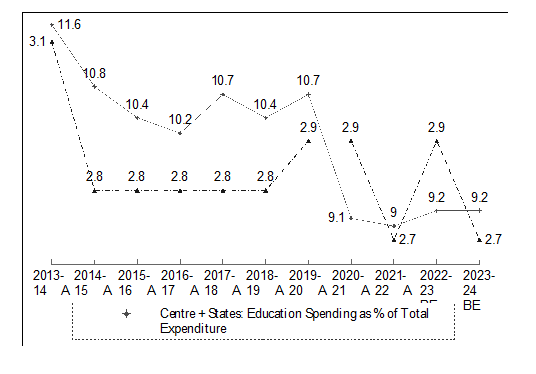
Source: Economic Survey, various years. Note: For definitions of BE (Budget Estimate), RE (Revised Estimate) and A (Actual), see Appendix 2.
In terms of Union Budget allocations, in its very first year after coming to power, the Modi Government reduced education spending from Rs. 71,321 crore in 2013–14 A (UPA’s last year) to Rs. 68,874 crore in 2014–15 A. Over the next 11 budgets, spending rose to Rs. 1,28,650 crore in 2025–26 BE (Chart 4.2). Though this appears to be a nominal doubling, the average annual increase has been just 5.04 percent (CAGR), indicating stagnation in real terms.
A clearer picture emerges when comparing education spending to total Central government expenditure (or budget outlay). It declined by 44 percent—from 4.57 percent of total expenditure in 2013–14 A to 2.54 percent in 2025–26 BE. As a share of GDP, it fell from 0.63 percent to 0.36 percent (Chart 4.2). These figures reveal a substantial erosion of the government commitment to education—despite the promises made in NEP-2020.
Chart 4.2: Budget Allocation for Education, FY14–FY26 (Rs. crore)
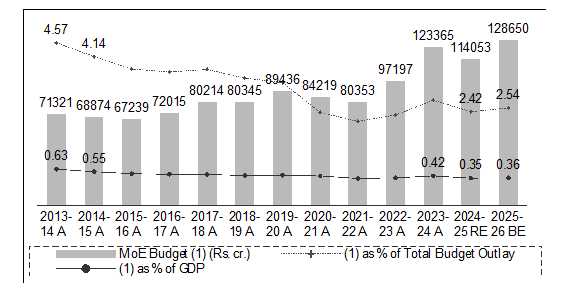
MoE: Ministry of Education
NEP and Reservations
A cornerstone of the Indian Constitution is its commitment to social justice for the historically marginalised and oppressed communities—SC, ST, OBC, religious minorities, nomadic and denotified tribes, and women—who together constitute nearly 85 percent of the population. In the field of education, this implies provisions for reservation in admissions and appointments of teachers in government educational institutions, along with scholarships, hostel facilities and financial aid to support students from these communities.
But NEP-2020 surreptitiously subverts this constitutional directive. The word ‘reservation’ is not mentioned anywhere in the 60-page policy document. Instead, it seeks to replace the entire Constitutional vision of social justice by the misleading exclusionary concept of ‘merit’ which represents the social privileges of the upper classes/castes inherited over generations. Because of this approach, the government has slashed scholarships for students from the most marginalised sections, and has introduced centralised exams for admissions that further disadvantage them (we discuss these issues later in this chapter).
Centralisation of Education
Another hallmark of the Modi Government’s functioning over the past decade has been its attempt to centralise education, undermining federalism. The Central Advisory Board of Education (CABE), comprising education ministers from both the Union and State Governments, has not been convened since September 2019. CABE was not consulted even when the Modi Government adopted NEP-2020.
Even though education is in the concurrent list, the Modi Government has sought to bully the State Governments to implement the PM-SHRI scheme of model schools by withholding the grants due to them under the Samagra Shiksha Abhiyan (SSA) as leverage (we discuss this in greater detail below). This is actually a flagrant violation of the constitutionally guaranteed Right to Education, as these funds constitute an important component of the funds needed by the State Governments to implement the RTE Act.
In higher education, the Centre has put out a new set of draft UGC guidelines for the selection and appointment of Vice-Chancellors of universities. These proposed changes completely deny State governments any say in the appointment of Vice-Chancellors in universities established, funded and operated by them, and transfer this to Centrally dominated statutory bodies. This allows the Union Government to bypass State government recommendations and plant individuals aligned with its ideology at the helm of State universities. This is a direct attack on the constitutional mandate that education is a subject on the Concurrent List, where both the Centre and States must have a say. Unsurprisingly, States ruled by non-BJP parties have vociferously protested these draft regulations, saying they would undermine the federal structure, diminish the powers of State legislatures, and weaken the autonomy of State universities.[6]
B. The Modi Years and School Education
NEP-2020 on School Education
When it comes to bombast, the Modi Government is unmatched. The NEP-2020 document envisions institutions where students feel welcomed, have diverse learning opportunities, and access to quality infrastructure and resources [NEP: Introduction]. Citing the 75th round NSSO survey (2017–18), the policy notes that 3.22 crore children aged 6–17 are out of school. Bringing them back to school and achieving universal enrolment by 2030 is declared a top priority (Section 3.1).[7]
For this, it outlines two major initiatives:
- Strengthening infrastructure, ensuring every school has trained teachers and is fully equipped. This includes upgrading existing schools, building new ones where needed, and providing transport or hostels (Section 3.2).
- Tracking students and their learning to ensure they remain enrolled or re-enter if they fall behind or drop out (Section 3.3).[8]
NEP-2020 and School Education Budget
NEP-2020 rightly emphasises expanding school infrastructure, increasing schools and teachers, and ensuring universal enrolment. But to implement this, significant budgetary support is needed—primarily from the Centre, which collects the bulk of the revenues in the country.[9]
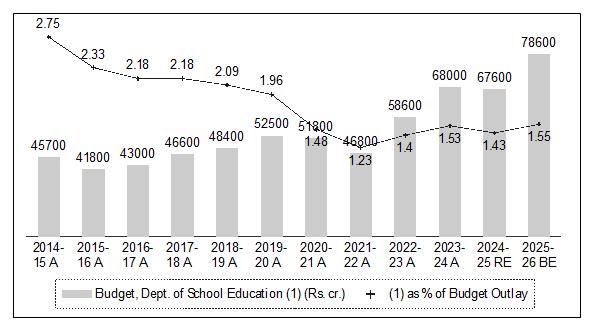
In the 12 budgets presented since 2014, the Modi Government has increased school education spending from Rs. 45,722 crore in 2014–15 A to Rs. 78,572 crore in 2025–26 BE (Chart 4.3), which means an average annual increase of only 5.05 percent (CAGR). This means spending has declined in real terms. A simple calculation shows that the 2025–26 BE allocation is 9.5 percent lower than actual spending for 2014–15 when adjusted for inflation.[10]
More tellingly, the budget of the Department of School Education and Literacy (DSEL) has fallen from 2.75 percent of total budget outlay in 2014–15 A to 1.55 percent this year—a 44 percent cut (Chart 4.3).
The Modi Government aspires to make India a Vishwaguru—without spending on educating its children!
Chart 4.3: Union Budget for School Education, FY15–FY26 (Rs. crore)
Budget for Elite Schools
In 2022, the Centre launched a five-year programme to upgrade 14,500 existing Central government / State / UT Government / local body schools to ‘high-quality schools’. These upgraded institutions have been given the pompous name Pradhan Mantri Schools for Rising India (PM SHRI schools). The website of the Ministry of Education says that the aim of developing these “exemplar schools” is to “showcase the implementation of the National Education Policy 2020”.[11] At this rate of upgradation, it will take more than 200 years to upgrade all the 10 lakh government schools in the country. Clearly, all the florid talk in NEP-2020 about providing good quality education to all children is humbug.
The budget allocation for PM SHRI schools this year is Rs. 7,500 crore (Table 4.1). The PM SHRI dashboard says that presently a total of 10,077 schools have been selected for upgradation under this scheme. Two other categories of schools on which the government spends a significant part of its school education budget are Kendriya Vidyalayas and Navodaya Vidyalayas (total budget Rs. 14,809 crore in 2025–26 BE) (Table 4.1).
Table 4.1: Budget for Elite Schools vs School Education Budget (Rs. crore)
| 2025–26 BE | |
| Kendriya Vidyalaya (1) | 9,504 |
| Navodaya Vidyalaya (2) | 5,305 |
| Exemplar / PM Shri (3) | 7,500 |
| Elite Schools, Total: 1+2+3 = 4 | 22,309 |
| (4) as % of School Education Budget | 28.4% |
There are presently 1,251 Kendriya Vidyalayas and 650 Navodaya Vidyalayas in the country. These two together with the 10,077 schools presently selected for upgradation to PM SHRI schools total 11,978 schools; this figure is 1.2 percent of the total government schools in the country (10.18 lakh). A total of 16.7 lakh students are studying in Kendriya Vidyalayas and Navodaya Vidyalayas. The government estimates that 18 lakh students will benefit from the first phase of the PM SHRI scheme (14,500 schools); so we can assume that 12.5 lakh students are studying in the 10,077 PM SHRI schools presently functioning. Adding up these numbers, this means that a total of 29.2 lakh students are studying in these 3 types of elite schools. This number is 2.3 percent of the total 12.75 crore students presently studying in government schools.[12]
For these 3 categories of elite schools, which account for a mere 1.2 percent of all government schools and 2.3 percent of the government-school students, the Centre is allocating 28.4 percent of the school education budget (Table 4.1)!
We have pointed out above that the Modi Government has reduced the school education budget in its Union Budgets between 2014 and 2025 by 9.5 percent. But a significant and increasing part of this budget is going for elite schools; if we deduct this spending from the total school education budget, the decline in budgetary spending for the 98 percent students studying in ordinary government schools over this 11-year period (2014 to 2025) works out to a huge 27 percent.[13]
There are other serious problems with the Modi Government’s push for PM SHRI schools. The Centre has announced that it will open PM SHRI schools only in those States that accept NEP in totality; this is thus a roundabout way of imposing NEP on States—yet another violation of federalism. Another condition is that the Centre will fund these schools for only 5 years, after which the States must take over full funding. According to news reports, three opposition-ruled States—Delhi, Punjab and West Bengal—have refused to participate in the PM SHRI scheme, arguing that education is a subject in the concurrent list, and the Centre can’t impose this scheme on them. The Modi Government has retaliated by stopping release of SSA funds to these State governments.[14]
Consequence of Declining School Education Budget
i) Severe Shortage of Classrooms and Other Facilities
NEP-2020 promises to ensure that “no school remains deficient on infrastructure support.” Yet, beyond a few elite schools like PM SHRI, the Centre has severely underfunded the remaining 99 percent. Consequently, many schools do not have the minimum number of classrooms needed—a fundamental infrastructure requirement. According to UDISE data[15] for 2017–18 (data for subsequent years is not available, suggesting conditions may have worsened):
- 55,226 schools (of which 49,420 were primary schools)—3.5 percent of all schools—had only one classroom or none. 80 percent of these (43,672) were government schools, including nearly 3,800 upper primary / secondary / higher secondary schools.[16]
- 57 percent of all primary schools (all managements) had three or fewer classrooms.[17]
Many schools suffer from dilapidated buildings and rickety furniture; 44 percent do not have a boundary wall.[18] Some schools still do not have access to electricity. The 2022 ASER report found that 24 percent of rural elementary schools even lacked drinking water facilities.[19]
In his 2014 Independence Day speech, PM Modi vowed to build separate toilets for boys and girls in all schools within a year. In 2015, he claimed near-completion, and in 2016, the HRD Ministry declared 100 percent achievement.[20] Six years later, the 2022 ASER report revealed that 31.6 percent of elementary schools still lacked usable toilets for girls.[21]
ii) Decline in Number and Quality of Teachers
The introduction to NEP-2020 highlights the importance of good quality teachers. It calls for recruitment of the “best and brightest” by ensuring “livelihood, respect, dignity, and autonomy”.[NEP: Introduction][22]
However, the gap between this rhetoric and actual policy under the Modi Government is stark. Official data shows a decline in both the number and quality of teachers in government schools:
- In 2017–18, of the total 8.4 lakh primary schools in the country (all managements), 80,623 (9.57 percent) were single-teacher schools, with 70,235 being government-run.
- Shockingly, 24,479 upper primary, secondary and higher secondary schools were also single-teacher schools, including 15,398 government schools.[23]
- By 2023–24, there were 1.1 lakh single-teacher schools serving nearly 40 lakh students[24]—an increase over six years, despite NEP’s lofty promises.
- Over 70 percent of primary schools (all managements) had three or fewer teachers (data for 2015–16, after which the government has stopped releasing such data).[25]
- Despite this severe shortage of teachers, the total number of teachers in government schools actually declined between 2016–17 and 2021–22, before increasing slightly. Overall, during the Modi years, the total number of government school teachers rose only marginally—from 49.31 lakh in 2014–15 to 50.38 lakh in 2023–24 (Chart 4.4). With permanent recruitment virtually at a standstill, most new appointments are likely on a contractual basis.
These figures imply that one teacher handles multiple classes in a single room in a majority of the primary schools in the country. This situation prevails in many senior-level schools as well.
Many teachers also lack professional qualifications. As of 2017–18, 15 percent of government teachers and 27 percent of private unaided school teachers were not professionally trained (subsequent UDISE reports have stopped reporting this data.)[26] These are alarming numbers for any education system concerned with quality. But NEP-2020 does not even acknowledge this problem!
Chart 4.4: Total Teachers in Government Schools, FY15–FY24 (in lakh)
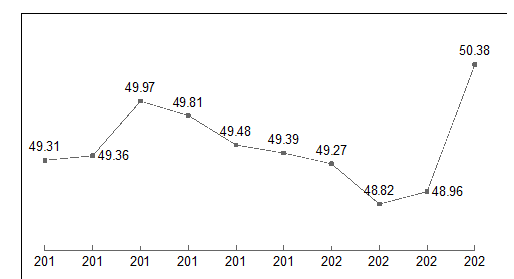
Source: All data from UDISE and UDISE+ reports, various years.
NEP-2020 also ignores the deteriorating service conditions and growing contractualisation of teachers—a trend linked to the privatisation of education since the 1990s. In 2017–18, 13 percent of government teachers (6.7 lakh) were contract or part-time.[27] Though recent UDISE reports show an increase in teacher numbers, many are likely semi-trained contract staff.
NEP, in fact, promotes contractualisation by advocating the recruitment of “local teachers” while remaining silent on their service conditions—suggesting they will be poorly paid contract workers (Sections 2.3 and 5.6).[28]
Without a decent pay and job security, why will the “best and brightest” youth enter the teaching profession? NEP worsens the situation by proposing a ‘tenure track system’ for appointment and confirmation of teachers (Section 5.17).[29] Under the earlier system, teachers were made permanent after a defined probation period. The new system will allow school managements to keep teachers on contract for extended periods—undermining their “respect, dignity, and autonomy.”
The policy also quietly eliminates reservation in recruitment and promotion of teachers. As mentioned earlier, the word ‘reservation’ does not find any mention in the NEP document. Instead, it says: “A robust merit-based structure of tenure, promotion, and salary structure will be developed” (Section 5.17), and further, that “Vertical mobility of teachers based on merit will … be paramount” (Section 5.19).[30] The NEP thus promotes the misleading notion of ‘merit’, which in reality reflects and reinforces the inherited advantages of privileged upper castes and classes—thereby sidelining the core values of equity and inclusion enshrined in the Constitution.
iii) Sharp Reduction in Scholarships for School Students
Previous governments had been sensitive to promoting education among disadvantaged sections of Indian society and had instituted several scholarships to encourage their school enrolment. In a complete reversal of its election promise to support education for SCs, STs and OBCs, the Modi Government has scrapped or scaled down most of these scholarship schemes. These include:
- the pre-matric scholarship for Class 1–8 students belonging to SC, ST, OBC and minority communities;
- the National Scheme for Incentive to Girl Child for Secondary Education (scholarship SC/ST girls);
- the Begum Hazrat Mahal National Scholarship for meritorious girls pursuing higher secondary education.[31]
iv) High Drop-Out Rate
It is, therefore, unsurprising that a large proportion of students who enrol in Class 1 do not complete even elementary education. Dropout rates, based on 2021–22 data, are alarming:
- Elementary level: 21.2 percent (meaning only 78.8 out of every 100 students enrolled in Class 1 complete Class 8).
- Secondary level: 46.6 percent (of 100 children enrolled in Class 1, only 53.4 complete Class 10).
- Senior secondary level: Just 41.9 out of 100 students make it to Class 11.[32]
v) Declining Quality of Education
Even among those who complete elementary education, the quality of education imparted is so poor that many can barely be considered educated! The Annual Status of Education Report (ASER)—a nationwide rural household survey by the NGO Pratham—presents a sobering picture of learning outcomes. Its 2022 report found that:
- 57 percent of Class 5 students couldn’t read a Class 2-level text;
- 30 percent of Class 8 students still couldn’t read a Class 2-level text; and
- 55 percent of Class 8 students were unable to solve a basic division problem.
Worse still, learning outcomes have steadily declined over the past decade:
- The share of Class 5 students able to read a Class 2-level text dropped from 47 percent in 2012 to 43 percent in 2022.
- The share of Class 8 students who could solve a simple division problem fell from 48 percent to 45 percent over the same period.[33]
Result: Decline in Public Education
i) Decline in School Enrolment
The deterioration in government school quality under the Modi regime has led to a mass exodus of students from government schools. The high fees of private schools have led to a decline in private school enrolment also, especially in the post-pandemic period. As a result:
- Enrolment in government schools (including pre-primary) fell by 36.23 lakh over the 5-year period 2018–19 to 2023–24;
- Total enrolment in all schools (government and private) dropped by 1.22 crore over the same period (Chart 4.5).[34]
Chart 4.5: Student Enrolment in Schools, FY19–FY24 (in crore)
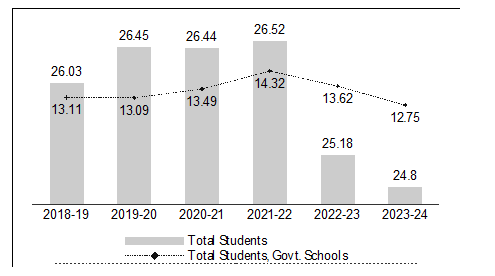
Total students includes students in government schools, local body schools, aided schools and private aided schools, and includes students from pre-primary to higher secondary. Data for government schools does not included government aided schools.
Source: All data from UDISE and UDISE+ reports, various years.
This decline is set to worsen as NEP-2020 proposes merging schools within a 5–10 km radius into “school complexes/clusters,” each comprising a secondary school and all lower-grade institutions nearby, including Anganwadis (Section 7.6).[35] This replaces the earlier policy of having schools within 1 km (primary) and 3 km (upper primary) of a child’s home. In Maharashtra alone, the decision of the State government to close down nearly 15,000 schools is going to affect 1.85 lakh students. Few of these parents are likely to send their children to schools 5–10 km away, as they would have to travel by bus.[36]
This can mean only one thing—the Modi Government is simply not interested in providing good quality education to all our children. While showcasing a few elite PM SHRI schools, it is ruining the quality of the remaining 99 percent of our public education system. As lakhs of children are pushed out of school, those who can afford it are shifting to private schools.
The worst sufferers of this ‘education crisis’ are obviously children from the weakest sections, especially from Dalit, Adivasi and minority families, and girl children. They form the bulk of the dropouts.
ii) Closure of Government Schools
The government is using this declining enrolment as an excuse to shut down government schools. Over the decade 2014–15 to 2023–24:
- 89,460 government schools have been shut down—their number falling from 11.07 lakh to 10.18 lakh (Chart 4.6).
As implementation of NEP-2020 advances and State governments merge schools into school complexes / clusters, the pace of government school closures is set to accelerate. As mentioned above, in Maharashtra alone, the State government has given its approval to shut down 14,783 schools as part of this consolidation.
Parallel to this decline in government schools, private unaided schools are sprouting up all over the country like mushrooms. Over the period 2014–15 to 2023–24, their number increased by 42,950.
However, the increase in private schools has not been sufficient to offset the decline in government schools. As a result, the total number of schools across the country fell by 87,000—from a peak of 15.59 lakh in 2017–18 to 14.72 lakh in 2023–24 (Chart 4.6).
Chart 4.6: Number of Schools by Management, FY15–FY24 (in lakh)
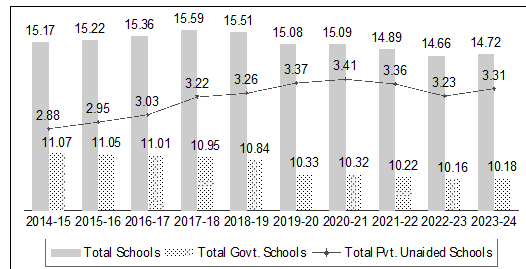
Total schools includes government schools, government-aided schools, private unaided schools and unrecognised schools and other schools; government schools does not include government aided schools; private unaided schools does not include unrecognised and other schools. See Appendix for detailed data.
Source: UDISE and UDISE+ reports, various years.
Skills for Poor, Elite Schools for Rich
i) Vocationalisation of School Education
The Modi Government has a plan for children dropping out of formal education: push them into vocational training, so that they can become cheap semi-skilled child labourers for corporate houses.
That’s the true intent behind NEP-2020, and hence it was imposed on the nation in the midst of the pandemic. NEP proposes “alternate programmes” for children who can’t attend school, such as “vocational education courses/programmes” (Section 3.5).[37] So rather than finding ways to bring back to school all children who are out of school, NEP calls for giving them vocational training in the guise of education.
NEP equates vocational and academic streams, and gives students the ‘choice’ of opting for either of these. It calls for introducing students to vocational crafts in Classes 6–8 (Section 4.26), and then gives them the option to exit after Class 10 and return later for vocational or other courses in Classes 11–12 (Section 4.2).[38]
ii) Elite Schools for the Rich
A wide range of schools of varying quality—both in terms of education and extra-curricular facilities, and therefore in fee structures—are opening up across the country for upper-class children. For the very rich, there are a small number of elite private schools.
School education has become a very profitable business. Some of India’s biggest corporate houses are entering the sector and opening five-star schools for the super-rich. In Mumbai, schools like Dhirubhai Ambani International School, Podar World School, the Aditya Birla Group’s New Era School and Oberoi International School offer fully-wired campuses equipped with cutting-edge technology, AC classrooms, and top-tier facilities like gyms, auditoriums, swimming pools, and studios. Fees can exceed Rs. 15–30 lakh per year.
This is the essence of globalisation. It means the building of a nakedly capitalistic, dog-eat-dog world. In this ‘free-market’ society, freedom means: if you have money, you can access the best education, healthcare, food and housing; if you don’t have money, you have the ‘freedom’ to remain illiterate, go hungry, sleep on the streets or die of curable diseases.
iii) A Discriminatory Education Model
NEP thus advocates a multi-tiered education system:
- Elite private schools for upper castes and wealthy families.
- A few well-funded government schools (Kendriya / Navodaya Vidyalayas and PM SHRI schools) for children of government employees and a lucky few from middle class families.
- Underfunded government schools with inadequate infrastructure and teachers, serving the vast majority of poor and marginalised children—who will be encouraged to opt for vocational courses and pursue their caste-based family occupation or take up whatever low-wage jobs are available in the market.
The Modi Government’s NEP-2020 is the first policy since independence to deny formal classroom-based school education to children from the weaker sections of society.
Burial of the Constitutional Dream
Back in the 1960s, commenting on what was then a small stream of elite ‘public schools’ (a term used for private schools in India), the Kothari Commission had observed:
The so-called Public Schools (that is, private schools) . . . system was transplanted in India by British administrators and we have clung to it so long because it happened to be in tune with the traditional hierarchical structure of our society. Whatever its past history may be, such a system has no valid place in the new democratic and socialistic society we desire to create (Section 1.38).[39]
The fine educationists who authored the Kothari Commission report could scarcely have imagined that this narrow stream of private schools would one day swell into a flood. While government schools are being shut down by the thousands, and government school enrolment is declining by the lakhs, private schools have expanded rapidly—recognised private unaided institutions now make up nearly a quarter (22.5 percent) of all schools in the country, and over one-third (36.3 percent) of all students are enrolled in them.[40]
Universal Public Education: Key to National Development
India’s rulers never tire of claiming that the country is on the path to becoming a developed nation. But history clearly shows that an essential prerequisite for development is universal education. All developed countries, during the initial stages of their development, prioritised free, compulsory, equitable and good quality elementary education for all their children—and later expanded it to secondary and higher secondary levels. Despite being free-market economies, they achieved this entirely through public funding, recognising that the private sector cannot fulfil this critical national goal.
As Professor Praveen Jha of Jawaharlal Nehru University points out, India’s policymakers refuse to heed this crucial historical lesson. Providing good quality school education to all children, especially during the early to middle stages of economic development, must be the State’s responsibility. Even today, in most OECD countries [41], only about 10 percent of students attend private primary schools—many of which are government supported. No country has ever achieved universal education without substantial and sustained public investment. [42]
A recent resolution of the UN Human Rights Council acknowledged that education privatisation poses a serious threat to the right to education. While India voted in favour of this resolution,[43] the Indian government continues to slash education budgets and promote privatisation—depriving millions of children, particularly those from marginalised communities, of even basic schooling.
Globalisation and neoliberal education reforms are not advancing development—they are exacerbating educational inequality and deepening underdevelopment.
The conclusion is inescapable: if India truly aspires to become a developed nation, it must guarantee quality education for all children—by significantly increasing public investment in education and strengthening public schools.
Notes
1. Shreya Roy Chowdhury, “BJP’s 2014 Manifesto Check: Has Modi Government Improved Education and Opportunities for Children?”, 3 April 2019, https://scroll.in.
2. National Education Policy 2020 Announced, 29 July 2020, https://pib.gov.in.
3. “Introduction”, New Education Policy 2020 [henceforth: NEP], MHRD, Government of India, p. 3, https://www.education.gov.in.
4. NEP, ibid., p. 10.
5. Ibid., pp. 60–61.
6. Sonia Gandhi, “The ‘3Cs’ That Haunt Indian Education Today”, 31 March 2025, https://www.thehindu.com; Nabeel Kolothumthodi, “Higher Education: How Centre is Undermining State Autonomy and Politicising UGC”, 25 April 2025, https://www.newsclick.in; “Southern Discomfort: On UGC Draft Regulations”, 22 February 2025, https://www.thehindu.com.
7. NEP, op. cit., pp. 5, 10.
8. Ibid., p. 10.
9. Of the total revenues of the Centre and States (including Centre’s borrowings), the Centre collects around 70 percent, and the States the remaining 30 percent. For more on this, see our article: Neeraj Jain, “Union Budgets 2014 to 2024, Article 7: Reduction in Social Sector Expenditures”, 2 February 2025, https://janataweekly.org.
10. Our calculation, assuming an average inflation rate of 6 percent per year.
11. PM Schools for Rising India (PM SHRI), https://dsel.education.gov.in, accessed on 23 July 2024.
12. All data for government schools and Kendriya Vidyalayas / Navodaya Vidyalayas taken from: UDISE + Report 2023–24, https://dashboard.udiseplus.gov.in/#/
13. Our calculation, assuming an average inflation rate of 6 percent per year.
14. Navneet Sharma, “Decoding PM-SHRI”, 16 September 2022, https://www.deccanherald.com; “Centre Stops School Scheme Funds to Delhi, Punjab & Bengal After States Refuse to Participate in PM-SHRI: Report”, 16 July 2024, https://www.deccanherald.com.
15. District Information System for Education (DISE), which was later upgraded to Unified District Information System for Education (UDISE), is a database about schools in India. The database was developed at the Department of School Education, Ministry of Education, Government of India and is maintained by National Informatics Centre, Government of India.
16. UDISE Flash Statistics 2017–18, NIEPA, New Delhi, http://udise.in/flash.htm.
17. This data is for 2015–16. Data for subsequent years is not available. Calculated by us from data given in: Elementary Education in Urban India, Analytical Report, 2015–16 and Elementary Education in Rural India, Analytical Report, 2015–16, NUEPA, New Delhi, http://schoolreportcards.in.
18. UDISE Flash Statistics 2017–18, op. cit.
19. Annual Status of Education Report (Rural) 2022, 18 January 2023, https://asercentre.org.
20. “English Rendering of PM’s Address to the Nation from the Ramparts of the Red Fort on the 69th Independence Day”, 15 August 2015, https://www.pmindia.gov.in; Swacchata Initiatives of Ministry of Human Resource Development, MHRD, 23 September 2016, https://dsel.education.gov.in; Devanik Saha, “PM’s Claim of Toilets for Girls in Every School Fails Scrutiny”, 12 September 2015, https://www.factchecker.in.
21. Annual Status of Education Report (Rural) 2022, op. cit.
22. NEP, op. cit., p. 4.
23. UDISE Flash Statistics 2017–18, op. cit.
24. UDISE + Report 2023–24, op. cit.
25. Calculated by us from data given in: Elementary Education in Urban India, Analytical Report, 2015–16 and Elementary Education in Rural India, Analytical Report, 2015–16, op. cit.
26. UDISE Flash Statistics, 2017–18, op. cit. Data for government teachers does not include teachers in government aided schools.
27. Ibid. Data for subsequent years is not available. Data does not include teachers in government aided schools.
28. NEP, op. cit., pp. 9, 21.
29. Ibid., p. 22.
30. Ibid.
31. “Union Government Stops Pre-Matric Scholarship for SC, ST, OBC and Minority Students of Class 1 to 8”, 29 November 2022, https://www.thehindu.com; “Centre Discontinues Incentive Scheme for Girl Students, Plans to Restructure the Scheme”, 27 July 2021, https://timesofindia.indiatimes.com; “Union Budget 2022: No Schooling Scheme for Poor Girls”, 2 February 2022, https://www.telegraphindia.com; “The Reality of Scholarship Schemes for Religious Minorities in India”, 27 August 2023, https://www.thehindu.com.
32. Calculations done by us, based on data given in: UDISE+ Flash Statistics, 2021–22, https://dashboard.udiseplus.gov.in. The methodology adopted by us is: We have taken the annual drop-out rate data for primary level, and used it to calculate the overall drop-out rate for primary education. Then, we have used the Transition Rate data and annual drop-out rate for upper primary level, to calculate the overall elementary level drop-out rate. Using the same methodology, we have calculated the drop-out rates for senior schools. UDISE+ reports for subsequent years give drop-out data from Class 3 onwards only, so we cannot update this calculation.
33. Annual Status of Education Report (Rural) 2022, op. cit. The figures are weighted average for children in government and private schools.
34. UDISE reports for 2022–23 and 2023–24 do not give separate data for pre-primary school enrolment, while DISE reports for 2014–15 to 2017–18 do not give data for school enrolment in pre-primary schools. So, we have given data from 2018–19 to 2023–24.
35. NEP, op. cit., p. 29.
36. “Maharashtra: Schools with Less Than 20 Students to be Merged to Create Clusters”, 24 September 2023, https://indianexpress.com.
37. NEP, op. cit., pp. 10–11.
38. Ibid., pp. 11–12, 16.
39. Report of the Education Commission, 1964–66, op. cit., pp. 10–11.
40. UDISE + Report 2023–24, op. cit.
41. OECD: Organisation for Economic Cooperation and Development, a grouping of 38 rich countries.
42. Praveen Jha et al., Public Provisioning for Elementary Education in India, op. cit.
43. Ambarish Rai, “Misguided Education Policy in Rajasthan”, op. cit.
[Neeraj Jain is a social activist and writer. He is the convenor of Lokayat, an activist group based in Pune. He is also the editor of Janata Weekly, India’s oldest socialist magazine. He has authored several books, including Globalisation or Recolonisation?, Education Under Globalisation: Burial of the Constitutional Dream, Nuclear Energy: Technology from Hell, and most recently, Union Budgets 2014-24: An Analysis.]