[This article is a part of a series of articles on ‘India’s Education Journey: From Macaulay to NEP’. This is the fifth part of this series. The previous articles have been published in previous issues of Janata Weekly.]
Neoliberal Winds: NPE-1986 / 1992
In 1986, the World Bank came out with a document, Report on Financing Higher Education in Developing Countries. It argued that since governments were short of funds, they should devote their limited resources to financing primary education, and subsidies for higher education should be eliminated. It reiterated the same perspective in another report released in 1994, Higher Education: The Lessons of Experience.[34]
These reports had an immediate impact on India’s education policy. The NPE-1986 (Section 11.2), formulated by the Rajiv Gandhi Government in 1986, and the revised NPE-1992 and PoA-1992 of the Narasimha Rao Government of 1992, all encouraged higher education institutions to raise their own resources and move toward self-reliance. The PoA-1992 explicitly suggested raising tuition and other charges, which had remained largely unchanged for 45 years (Section 11.14.2).[35]
In 1992, the University Grants Commission (UGC) set up the Punnayya Committee to suggest ways of resource mobilisation by universities. Two years later, the All India Council for Technical Education (AICTE) formed the Swaminathan Committee to explore similar strategies in technical education. Both faithfully came up with very similar recommendations: increasing tuition and other fees, adjusting them periodically to reflect rising costs, linking fees to employment prospects of courses, renting out university facilities (such as classrooms, playgrounds and lawns), reducing regular faculty and hiring contract teachers, and raising the teacher–student ratio.[36]
These recommendations implied an abandonment of the principle of public funding of higher education. They signalled that the country’s policy makers and educationists no longer saw universities as institutions meant “to furnish intellectual leadership and moral tone to society”, as articulated in the Report of the Committee on Model Act for Universities, 1961–64.[37] They were turning away from the Nehruvian vision of universities as “forums for a critical assessment of society”, and toward a view of higher education as private investment for individual profit. Higher education now began to seen as a means to employment, and this led to the proposition that those accessing higher education should pay for it. This logic was formally stated in a 1997 finance ministry discussion paper on government subsidies, which argued that higher education benefited only its recipients and not society as a whole. It recommended cutting subsidies to higher education from 90 percent to 50 percent within three years, and further to 25 percent in another two years.[38]
Reduction in Public Funding of Higher Education
In accordance with this new philosophy governing higher education, successive Central governments since the 1990s—from the Congress-led Narasimha Rao administration to the NDA under Atal Bihari Vajpayee and later the UPA under Manmohan Singh—made steady cuts in government funding for higher education.
By 2001–02, total government spending on higher and technical education had fallen to around 0.5 percent of GNP (Table 3.3)—far below the 1–2.5 percent typical of many developed countries, despite their higher GNPs and smaller populations.
Table 3.3: Govt. Spending on Higher and Technical Education (as % of GNP)
| Govt. Expenditure on Higher Education | Govt. Expenditure on Technical Education | |
| 1990–91 | 0.46 | 0.15 |
| 2001–02 | 0.39 | 0.12 |
Source: Report of the CABE Committee on Financing of Higher Education in India, June 2005, p. 24
Consequence: Decline in Quality, Fee-Hikes …
After putting a squeeze on government grants, in 2000, the HRD Ministry instructed universities and colleges to generate at least 7 percent of their maintenance costs through internal resources (that is, through fee hikes and other sources), increasing by 1 percent annually until reaching 15 percent. It also recommended differentiated fees by course, recovery of 75 percent of the recurring cost of library, laboratory, sports and computer facilities from students, revision of hostel fees to recover both recurring and partial capital costs, and also permitted institutions to fill 20 percent of seats with foreign/NRI students.[39]
This cut in public funding led to a noticeable decline in the quality of higher education. Budgets for libraries, labs, faculty development and research were slashed. Faculty recruitment in universities and colleges stagnated for more than a decade. A committee on financing of higher and technical education, set up by the Central Advisory Board of Education (CABE), admitted in its 2004 report that because of the unsatisfactory financial situation in higher education, “many institutions of higher education suffer from severe inadequacy of physical resources such as buildings, classrooms, libraries, laboratories, etc., not to speak of high-tech modern equipment …”[40]
The CABE committee report also noted that reduced public funding had forced universities and colleges to significantly raise fees. In addition to higher tuition fees, they had also introduced numerous other charges—including fees for entrance exams, admission, registration, libraries, laboratories, sports, convocation, certificates and even marksheets. In case of hostel fees and other such ‘student welfare’ services, institutions moved towards near-complete cost recovery. For example, in 1999–2000, Bangalore University earned only 2.2 percent of the total recurring income from tuition fees, but over 40 percent from all fees combined.
To generate additional resources, universities and colleges began offering ‘self-financing’ courses, even in traditional disciplines like political science, botany, or economics—subjects that should normally be publicly funded. In case of courses where there was growing demand, fees were often set far above actual costs.
WB Calls for Accelerated Privatisation
The acceptance of the World Bank-dictated neoliberal economic reforms in the 1980s–90s led the Indian Government to restrict funding for higher education, pushing it into crisis. Having succeeded in weakening public higher education institutions, the World Bank released a new report in 2000, Higher Education in Developing Countries: Peril and Promise. This urged developing countries to expand and improve higher education by encouraging entry of the private sector. It argued that market-driven competition, including from profit-oriented institutions, would enhance quality.[41]
Ambani–Birla Report
That same year (2000), another influential report, A Policy Framework for Reforms in Education, was released. This report was shockingly not the product of an academic committee, but was authored by industrialists Mukesh Ambani and Kumarmangalam Birla. The report had been commissioned by Prime Minister Vajpayee’s Council on Trade and Industry—and not by the MHRD or the UGC.
The Ambani–Birla report brazenly recommended privatisation of existing universities, and endorsed the establishment of new private universities by corporate houses in areas like science, technology and management where there was potential to generate profits. In non-profitable disciplines like “oriental languages, archaeology, palaeontology, religion and philosophy”, it recommended that the State should play an active role. It endorsed a strict ‘user-pays’ principle in higher education (with loans and grants for the economically and socially backward sections of society) to make investment in the education sector profitable for investors. Ambani–Birla also proposed opening up the higher education sector to foreign direct investment and high fee-paying foreign students.[42]
Strong protests from academicians and teachers’ unions forced the government to shelve the Ambani–Birla report. However, its recommendations have continued to influence the policy framework in higher education.
National Knowledge Commission Report
In 2005, the government constituted the National Knowledge Commission (NKC) to recommend policy reforms to “build excellence in the educational system”. The Commission was chaired by Sam Pitroda, an NRI known for his strong support of neoliberal policies. Its Report to the Nation 2006 submitted in 2007 echoed calls for further privatisation of the higher education sector. Additionally, in the name of expeditious decision-making, it proposed scrapping all democratic governing bodies in universities, such as university courts and academic councils, and increasing powers of Vice Chancellors so that they function like chief executive officers. This marked yet another assault on the Nehruvian vision of universities as spaces for democratic governance and critical thought.[43]
Eleventh and Twelfth Five Year Plans
The World Bank report of 2000, its virtual endorsement by India’s leading industrialists in the form of the Ambani–Birla report (which reads almost like an Indianised version of the former) and by the NKC, prompted the Indian Government to make an important policy shift in the early 21st century. It began aggressively promoting private sector expansion in higher education.
The Eleventh Five Year Plan (2007–12) announced a major thrust to expand capacity in higher education institutions (HEIs) so as to achieve a GER of 15 percent in higher education by 2011–12. To meet this target, it estimated that an additional enrolment of 8.7 lakh students in universities and 61.3 lakh in colleges would be required. It proposed a major part of this expansion to take place either in the private sector or through PPP. To encourage private sector investment in higher education, it called for granting financial autonomy to HEIs, so that they could raise funds through fees, consultancy and donations.[44]
The Twelfth Plan (2012–17) sought to raise GER in higher education to 25 percent by increasing student enrolment by 10 million, again mainly through private institutions. For achieving this target, it called for adoption of new models of PPP in higher education, innovative changes in legal provisions to encourage increased private sector investment in higher education, providing public funding to private unaided HEIs, and even permitting for-profit institutions to enter the education sector.[45]
This aggressive push for privatisation and profit-making in higher education triggered a private sector boom during the first decade of the new millennium.
The Private Sector Takes Off
Between 2000–01 and 2014–15, the number of universities in India (including Deemed Universities and Institutions of National Importance) increased from 256 to 760—a threefold increase in just 14 years. Colleges similarly tripled from 12,806 to 34,452 (Charts 3.5 and 3.6).
Chart 3.5: Number of Universities in India, 1950–51 to 2014–15
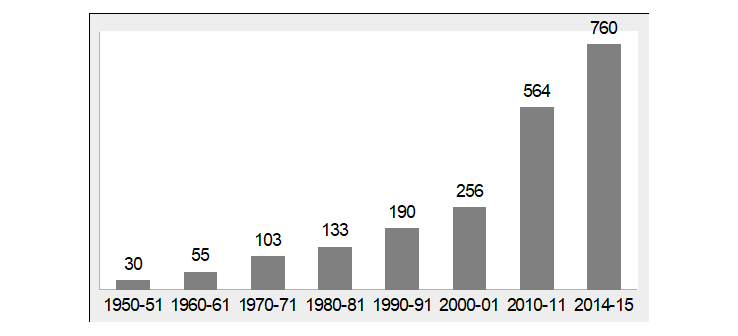
Chart 3.6: Number of Colleges in India, 1950–51 to 2014–15
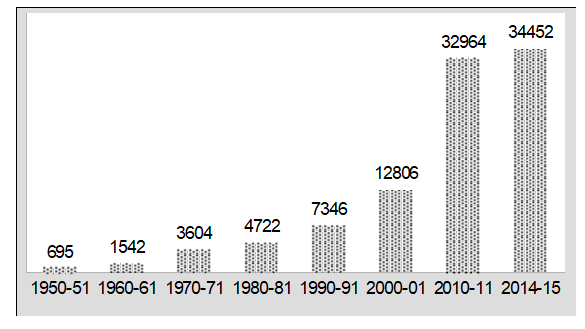
Source: Same as Chart 3.5.
This growth was largely driven by a surge in private unaided HEIs. As shown in Chart 3.7:
- Private unaided universities and colleges increased more than sixfold, from 3,223 to 21,971, during this 14-year period.
- In 2000–01, government HEIs outnumbered private ones; by 2014–15, private HEIs were 2.5 times the number of government institutions (21,971 vs. 8,373).
- Private HEIs were less than 25 percent of total HEIs in 2000–01; by 2014–15, they accounted for nearly two-thirds (62.4 percent).
Chart 3.7: Increase in Number of Private Unaided and Govt HEIs, 2000–01 to 2014–15
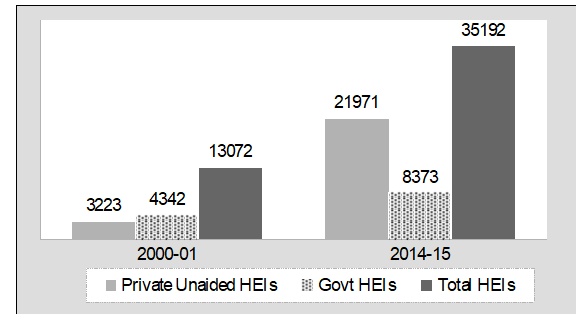
Source: Data for HEIs includes only universities and colleges, does not include stand-alone institutions. Total number of private and government HEIs in 2000–01 from: Pawan Agarwal, Higher Education in India – The Need for Change, ICRIER Working Paper, June 2006, p. 156, www.icrier.org. The data for 2014–15 is taken from: AISHE Final Report 2014–15 (see Data source, Chart 3.5). Note that in the data for 2000–01, the total number of universities is 266, while in Chart 3.5 this figure is 256. Also note that in the data for 2014–15, the data does not include those colleges that did not respond to the survey. Total number of colleges in 2014–15 were 38,498; of these, 34,452 responded to the survey. The total number of universities includes those that did not respond to the survey.
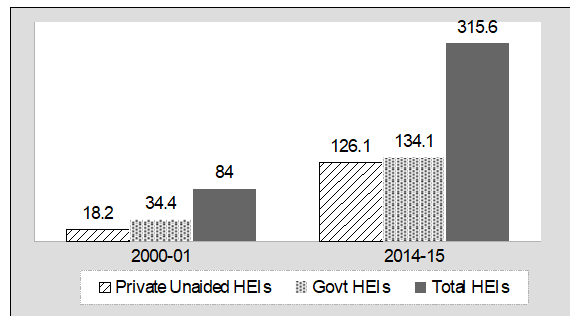
Chart 3.8: Private Unaided and Govt HEIs: Student Enrolment, 2000–01 and 2014–15 (in lakh)
Source: Same as Chart 3.7.
This dramatic increase led to a surge in student enrolment in private unaided HEIs—from 18.2 lakh in 2000–01 to 126.1 lakh in 2014–15. Nevertheless, in 2014–15, even though private unaided HEIs made up 62 percent of all HEIs, compared to just 24 percent for government HEIs:
- Government universities and colleges enrolled 1.34 crore students (42.5 percent of total enrolment),
- while private unaided HEIs enrolled 1.26 crore (40 percent of total enrolment) (Chart 3.8).
Student enrolment in government HEIs remained higher, primarily because fees in government colleges are significantly lower than those in private institutions.
This private sector–driven expansion led to a near tripling of India’s Gross Enrolment Ratio in higher education (excluding students in distance learning programmes) in less than two decades. It went up from 8.85 (1993–94) and 12.59 (2004–05) to 23.05 (2009–10).[46]
Notes
34. Vijender Sharma, Crisis of Higher Education in India, op. cit., Chapter 1.
35. NPE-1986, op. cit.; National Policy on Education-1986: Programme of Action 1992, pp. 69–70, https://www.education.gov.in.
36. Vijender Sharma, Crisis of Higher Education in India, op. cit., Chapter 3; UGC Funding of Institutions of Higher Education: Report of Justice Dr. K. Punnayya Committee, 1992–92, pp. 77–79, www.ugc.ac.in; N.V. Varghese, “Reforming Education Financing”, http://www.india-seminar.com.
37. Cited in: Triveni Educational & Social Welfare Society v. State of Haryana and ANR, Section 15, p. 11, https://www.casemine.com.
38. K.B. Powar, Indian Higher Education: A Conglomerate of Concepts, Facts and Practices, p. 196, http://books.google.co.in; Vijender Sharma, Crisis of Higher Education in India, op. cit., Chapter 1.
39. Vijender Sharma, ibid., Chapter 3.
40. Report of the CABE Committee on Financing of Higher Education in India, pp. 29–30, June 2005, https://www.education.gov.in.
41. Higher Education in Developing Countries: Peril and Promise, pp. 10–11, 45, Task Force on Higher Education and Society, http://www.tfhe.net.
42. Vijender Sharma, Crisis of Higher Education in India, op. cit., Chapter 9.
43. Vijender Sharma, “Privatisation of Higher Education is the Main Aim”, People’s Democracy, 18 February 2007, http://archives.peoplesdemocracy.in; Prabhat Patnaik, Alternative Perspectives on Higher Education in the Context of Globalization, 11 August 2007, http://www.nuepa.org.
44. Eleventh Five Year Plan, Vol. II: Social Sector, op. cit., pp. 23, 25, 31–32.
45. Twelfth Five Year Plan, 2012–17, Vol. III: Social Sectors, op. cit., pp. 96–100.
46. Based on NSS reports, cited in J.B.G. Tilak, How Inclusive is Higher Education in India? op. cit.
[Neeraj Jain is a social activist and writer. He is the convenor of Lokayat, an activist group based in Pune. He is also the editor of Janata Weekly, India’s oldest socialist magazine. He has authored several books, including Globalisation or Recolonisation?, Education Under Globalisation: Burial of the Constitutional Dream, Nuclear Energy: Technology from Hell, and most recently, Union Budgets 2014-24: An Analysis.]