[This article is a part of a series of articles on ‘India’s Education Journey: From Macaulay to NEP’. This is the fourth part of this series. The previous articles have been published in previous issues of Janata Weekly.]
Dismantling the Public School Education System
National Policy on Education 1986
The neoliberal winds from Washington blowing across India in the 1980s affected India’s education system too. In 1986, the Rajiv Gandhi-led Congress government introduced a new National Policy on Education (NPE-1986), and a companion Programme of Action, both approved by Parliament. In 1992, the Narasimha Rao-led Congress government made some changes to NPE-1986 (henceforth, NPE-1992) and also revised the Programme of Action (PoA-1992).
NPE-1986 introduced a stream of non-formal education (NFE) for “school drop-outs, for children from habitations without schools, working children and girls who cannot attend whole-day schools” (Section 5.8).[8] These out-of-school children comprised almost half of the children in this age-group.[9]
NPE-1986 claimed that NFE would be comparable in quality to formal education (Section 5.9), a claim reiterated in NPE-1992 (Section 5.9).[10] In reality, it legitimised an inferior stream of education parallel to formal education. Simultaneously, it proposed setting up an elite layer of schools, the Navodaya Vidyalayas, one per district, whose quality would be far superior to the regular government schools.
Thus, for the first time, the Indian state formally declared a discriminatory, multi-track education system. Until then, in principle, there was only one officially acknowledged and financially supported education system, comprising of government, local body and government-aided schools of comparable quality. There did exist a small number of fee-charging private unaided schools, to which the upper classes sent their children (Table 3.1). But until the 1980s, the majority of the middle classes continued to send their children to government schools.
Table 3.1: Total Schools, Government Schools and Private Unaided Schools, 1986
| Total Schools | Government Schools | Private Unaided Schools | |
| Number of Schools | 7,35,771 | 6,27,381 (85.3%) | 32,315 (4.4%) |
| Student Enrolment | 12,82,15,381 | 9,33,97,255 (72.8%) | 76,47,512 (6%) |
Source: Calculated from data given in: Fifth All India Educational Survey, Vol. 2, pp. 718–25, and pp. 1120–39, https://archive.org.
NPE-1986 acknowledged that the longstanding target of increasing expenditure on education to 6 percent of the national income was yet to be met. It promised to increase spending in the Seventh Plan (1985–90) and achieve this target by the Eighth Plan (Section 11.4). NPE-1992 repeated the latter promise (Section 11.4).[11] However, education spending reached only 3.9 percent of GDP in 1989–90, declined thereafter, briefly peaked at 4.3 percent in 2000–01, and then fell below 4 percent in the 2000s.[12]
This underfunding is the real reason for introducing a low-quality education system for the poor. A report tabled in Parliament in 1985, titled Challenge of Education – A Policy Perspective, shamelessly admits that since the objective of universalisation of elementary education needed to be adjusted with financial constraints, therefore NFE had been adopted as a cost-cutting solution—clearly aimed at children of the marginalised sections.[13] From the perspective of the new elites that were now dominating policy making in India, teaching the poor some literacy–numeracy was deemed sufficient.
NPE-1986 also sanctioned replacing trained, well-paid teachers with instructors from local communities. It added, “Steps will be taken to facilitate their entry into the formal system in deserving cases” (Section 5.9), implying that they would be recruited on a contract basis. But this proviso was removed in the 1992 policy (Section 5.9).[14] Along with legitimising non-formal education, NPE-1986 and NPE-1992 thus also sanctioned recruitment of contractual, underpaid, less qualified teachers.
These moves starkly violated Articles 14, 15(1) and 45 of the Constitution, which mandate equitable, non-discriminatory education for all children. With NPE-1986 and its 1992 version, India’s ruling elites thus formally abandoned this Constitutional commitment.
SAP and Elementary Education
After taking the Structural Adjustment Loan from the WB–IMF in 1991, the Indian Government began implementing World Bank-dictated education reforms in right earnest. These reforms had been outlined in the Jomtien Declaration issued at the end of a World Bank-sponsored international conference on education held in Jomtien, Thailand in March 1990. The Indian Government too had signed this Declaration. The basic agenda of these reforms was straightforward:
i) Starve the vast government education system, from schools to universities, of funds; consequently, their quality would gradually deteriorate.
ii) With decline in school quality, parents, including even poor parents, would gradually begin to withdraw their children from the government education system.
iii) This would create a demand for private schools, enabling the private sector to set up low-fee charging inferior quality schools for poor children, and high-fee charging elite schools for the rich.
iv) Meanwhile, the declining enrolment in government schools would give an alibi to the government to close them down; the school campuses could then either be handed over to private schools, or be converted into commercial ventures like shopping malls.[15]
The Assault: DPEP–SSA
To implement this agenda, the Ministry for Human Resource Development (MHRD) (the new name of the Ministry of Education) launched the World Bank-sponsored District Primary Education Programme (DPEP) in 1993–94. Beginning with 42 districts in 7 states, the DPEP expanded to almost half of India’s districts (about 280) across 18 states by 2002–03.
In just a decade, DPEP inflicted serious damage on the Indian education system. Its effects included:[16]
- Reducing holistic education to literacy–numeracy;
- Replacing the Constitutional commitment to provide eight years of elementary education with five years of primary education;
- Introducing inferior education streams like adult literacy classes, education guarantee centres and correspondence courses parallel to formal education;
- Replacing regular teachers with underqualified, ill-trained and underpaid contractual teachers, called para-teachers;
- Introducing multi-grade teaching wherein one teacher teaches multiple classes in the same classroom;
- Reducing State responsibility to provide education by allowing NGOs to enter this sector.
In less than a decade, the DPEP ‘succeeded’ in its agenda of undermining the quality of the government school system, leading to a significant decline in its public credibility.
Note that several Central governments changed during this period, but the World Bank-driven neoliberal education agenda continued uninterrupted.
In April 2000, the World Bank convened another global education conference in Dakar, Senegal as a follow-up to the Jomtien Conference. In accordance with the decisions taken at this conference, the Indian Government rebranded DPEP as the Sarva Shiksha Abhiyan (SSA). A decade later, by 2010, the government school system was in shambles. The World Bank had succeeded in its goal of weakening the government school system, thus creating the foundation for commercialisation of school education and the rapid expansion of private schools in India.
Right to Education Act
The Unnikrishnan Judgement
Meanwhile, putting an obstacle to the plans of the World Bank and a pliant Government of India, a five-judge bench of the Supreme Court of India gave an unprecedented ruling upholding the spirit of the Constitution of India. In 1993, in J.P. Unnikrishnan vs State of AP, the Supreme Court ruled that Article 45 in Part IV of the Constitution should be read in “harmonious construction” with Article 21 (right to life) in Part III of the Constitution, and concluded:
The right to education flows directly from the right to life. The right to life under Article 21 and the dignity of an individual cannot be assured unless it is accompanied by the right to education.
Referring to the 10-year time frame set by Article 45 for providing education to all children up to the age of 14 years, the Court asked: “Has it no significance? Is it a mere pious wish, even after 44 years of the Constitution?” And so the Supreme Court concluded that the right to education for children up to the age of 14 is a fundamental right, thereby making it legally enforceable.
Need to Amend Article 45: Free Education till 18 Years
Any pro-people government would have welcomed the Unnikrishnan judgement. Not only that, it would have sought to expand its scope to include all children up to the age of 18, ensuring free and compulsory education up to Class 12. When the Constitution was adopted, India had just emerged from 200 years of colonial exploitation and faced a severe resource crunch, which partly justified limiting free education to children up to the age of 14 (i.e., Class 8). But four decades after independence, by the early 1990s, with significant wealth creation and development having taken place, India could certainly afford to guarantee free and compulsory education for all children up to Class 12.
Indeed, most advanced developing countries like China, Mexico, Brazil, Thailand and Indonesia had long achieved universal elementary education and were now engaged in universalising quality secondary education.[17]
Providing free education up to Class 12 was also essential from another perspective—without this qualification, young people had virtually no chance of securing decent employment. Even forty years after independence, only about 10 percent of OBC, 8 percent of SC and 6 percent of ST students (out of those who entered Class I) managed to complete Class 12[18]—meaning that only this small fraction could benefit from constitutional reservations. The exclusion of a majority of Muslims from higher education and public employment also stemmed from their socio-economic status, which was comparable to that of SCs and OBCs. Therefore, denying free education to all children up to the age of 18 made a mockery of the fundamental right to equality provided by the Indian Constitution under Articles 15 and 16.
Subverting the Judgement: 86th Amendment
Instead of spurring the Indian Government to take steps to provide free, quality education to all children up to the age of 18 years, the Unnikrishnan judgement—granting children in the age group 0–14 the fundamental right to education—sent shivers down the spine of India’s political leadership. It was in direct opposition to neoliberalism.
For nearly a decade, successive Central governments sat on the judgement, trying to figure out a way of reconciling it with the requirements of the WB-dictated SAP.
Finally, in November 2001, the Vajpayee-led NDA Government introduced the 86th Constitutional Amendment Bill in Parliament. Though its ostensible purpose was to implement the Unnikrishnan judgement, its real aim was to dilute its impact.
The Amendment made two important changes to the Constitution:
- Inserted Article 21A (after Article 21), which read: “The State shall provide free and compulsory education to all children of the age of six to fourteen years in such manner as the State may, by law, determine”;
- Redrafted Article 45, replacing: “The State shall endeavour to provide, within a period of ten years from the commencement of this Constitution, for free and compulsory education for all children until they complete the age of fourteen years”, with: “The State shall endeavour to provide early childhood care and education for all children until they complete the age of six years”.
These changes cleverly took away the fundamental right to education granted by the Supreme Court to the country’s children, by:
a) Denying 0–6-Year-Olds the Right to Free Early Childhood Care and Pre-Primary Education: Early childhood care (which includes nutrition), nursery and pre-school education are vital for a child’s cognitive and emotional development. Through this Amendment, the government denied almost 17 crore children in the age group 0–6 years this fundamental right, thereby deepening inequality—wealthier families will be able to afford private care for their children, while poor children will be debilitated for the rest of their lives due to this deprivation in early childhood.
b) Weakening the Right of Children of 6–14 Years to Free, Equitable Education: Even for the 20 crore children in the 6–14 years age group, the Amendment restricts their fundamental right to education by the phrase “as the State may, by law, determine” (in Article 21A). This legitimises the parallel low-budget low-quality education streams for poor children introduced under NPE-1986.
This duplicitous intention is further exposed by the Financial Memorandum attached to the Bill, which allocated just Rs. 9,800 crore annually over 10 years for implementing the Amendment’s provisions. This is far less than estimate of Rs. 14,000 crore annually for 10 years made by the government’s Tapas Majumdar Committee in 1999 to fund formal elementary education for all out-of-school children.[19]
Several MPs criticised the Bill. But they were just blustering; their parties were in agreement on implementing the neoliberal economic reforms. The Bill passed both houses of Parliament without a single dissenting vote! The President signed it into law in December 2002.
Right to Education Act
Article 21A introduced into the Constitution through the 86th Amendment stated that the State shall provide free and compulsory education to all children aged 6–14 “in such manner as the State may, by law, determine.” The State was now required to pass legislation detailing how it would implement this right. However, the NDA Government, which had piloted the Amendment through the Parliament, was voted out in the 2004 elections, before it could pass the necessary law.
The new UPA Government that came to power in May 2004 shared the previous NDA Government’s intent to dilute the fundamental right to education granted by the Supreme Court. It burned the midnight oil and came up with a bill aligned with the neoliberal agenda. The final Bill was passed by the Parliament in August 2009, and the Right of Children to Free and Compulsory Education Act—popularly known as the Right to Education (RTE) Act—came into effect on 10 April 2010.
The media celebrated the Act as a ‘historic law’, claiming India had joined the ranks of countries where education is a fundamental right of every child. The MHRD claimed on its website that the Act ensured that “every child has a right to full-time elementary education of satisfactory and equitable quality in a formal school which satisfies certain essential norms and standards.”
However, a closer reading reveals that the Act guarantees education to all children in a flawed and limited manner.
Flaws in the RTE Act
i) Does the RTE Act guarantee free education to all children?
Nowhere in the text of the Act is it stated that children will be provided completely free education. The Act clearly defines ‘free education’ to mean that no child shall be charged fees that prevent them from pursuing elementary education, implying that some fees can still be charged.
ii) How does the Act propose to provide compulsory elementary education for the 8 crore out-of-school children?
The Act makes no special provision for this. Bringing crores of out-of-school children back to school will require massive public investment in building schools and recruiting teachers. The government is instead closing schools.
iii) Does the Act guarantee equitable education for all children?
No. Instead, it legitimises the four existing categories of schools—government, government-aided private, elite government (Navodaya Vidyalayas and Kendriya Vidyalayas), and private unaided schools.
iv) Will it improve school infrastructure?
The ‘Norms and Standards for a School’ given in the Schedule attached to the Act are extremely deficient, and even permit a single teacher to teach multiple classes in the same classroom. Even these inadequate norms are being barely implemented, because of lack of political will. The RTE Act set a deadline of three years for schools to implement the norms (ending 31 March 2013). A year later, an MHRD study found that only 8.3 percent of schools had met all 10 norms, and 21 percent had fulfilled at least 7 norms.[20]
v) Will the Act improve quality of teachers?
No. It does not prescribe any qualifications for teachers or guidelines for service conditions, implying that underqualified, poorly trained contractual teachers will continue to be employed in schools.
vi) Does it ensure sufficient funds for elementary education?
No. The Act does not have any financial memorandum attached to it.
vii) Does the Act regulate the high fees charged by private schools?
No. On the contrary, it allows private schools to charge any amount of fees from 75 percent of students, as long as it is disclosed upfront.
viii) At least the provision of 25 percent reservation in private schools for children from marginalised groups will ensure good education for them?
This provision of the Act states that unaided private schools must admit at least 25 percent of Class I students from weaker and disadvantaged sections and provide free elementary education to them, with the State reimbursing them up to the per-child expenditure in government schools.
There is much hype that this will ensure ‘good quality’ education for poor children by enabling them to take admission in private schools.
Firstly, there aren’t enough private unaided schools. HRD Ministry data for 2010 showed that they could have admitted at most 18 lakh children in Class I under the 25 percent quota, while 2 to 2.5 crore children would still have to rely on the neglected government school system.[21]
Secondly, not all private schools provide better quality education than government schools, as concluded by a study by the Azim Premji Foundation.[22] On the other hand, if the government wants, it can indeed run excellent schools, as Navodaya and Kendriya Vidyalayas prove. If the quality of government schools is deteriorating, it is a deliberate policy decision—because of WB-driven reforms. The RTE Act’s provision for reservation in private schools means that the government has decided to abdicate its responsibility for improving the quality of government schools.
Private schools are resorting to all kinds of stratagems to deny admission to poor children. Six years after the RTE Act, an IIM Ahmedabad survey found that only 15 percent of the 2.29 million reserved seats in private schools had been filled.[23]
In truth, this is a very regressive provision. Private schools operate as profit-driven institutions, and poor children admitted under this quota are likely to face discrimination and exclusion. Teachers and students from affluent backgrounds may treat them condescendingly. These children will also find it difficult to meet the exorbitant and arbitrary ancillary costs of private schools. This could eventually force these students to drop out; even if they somehow continue studying, they are likely to develop a deep sense of inferiority.
Despite these issues, the Supreme Court too upheld this provision, instead of demanding that the government improve public education. It has thus allowed the violation of Articles 14 (Equality before law), 15 (Prohibition of discrimination), 16 (Equality of opportunity in public employment) and 21 (Right to life with dignity) of the Constitution.
Post-RTE Act, the PPP Storm
Clearly, the 86th Constitutional Amendment and the RTE Act:
- fail to ensure free and compulsory education of equitable quality for all children as mandated by the Constitution;
- fail to reverse the decline in the government school system that began with the neoliberal reforms.
The UPA Government’s lack of seriousness about universalising elementary education is evident from the Eleventh Plan (2007–12) document. This was drawn up by the Planning Commission while the government was finalising the RTE Act. Its financial provisions reflect the government’s priorities—education spending remained far below the Kothari Commission’s recommended 6 percent of GDP. Here, it would be relevant to mention that many educationists argue that, due to decades of underfunding, public spending on education needs to be raised to at least 8–10 percent of GDP to meet even modest educational goals.[24]
The Eleventh Plan identified the Sarva Shiksha Abhiyan (SSA) as the main program for universalising elementary education, implying that it was the main scheme for implementing the RTE Act. Following the passage of the RTE Act, an HRD Ministry committee estimated the total cost of universalising elementary education to be around Rs. 1.71 lakh crore over five years.[25] However, the Eleventh Plan allocated less than half of this for the SSA—Rs. 71,000 crore (with actual spending Rs. 78,000 crore).[26]
Privatisation Storm
While refusing to allocate adequate resources to improve government schools, the UPA Government simultaneously launched a full-fledged drive to privatise the government school system. To maintain the illusion of commitment to universal education, it promoted privatisation under the rhetoric of ‘Public–Private–Partnership’ (PPP).
PPP is essentially a fraudulent concept promoted by global financial institutions as a tool to transfer public funds and assets to the private sector. Under this ‘partnership’, public resources (land, mineral wealth, public sector corporations, etc.) are transferred to private entities at concessional rates. These entities are guaranteed a minimum rate of return, with the government covering any shortfall; the government often even provides the investment money upfront as long term concessional loans.[27] What a partnership!
Initially crafted for infrastructural investments, the UPA Government extended PPP to education. The Eleventh Plan, while not increasing education funding, unashamedly advocated PPP in education.[28] This means handing over school management, teacher appointments, curriculum, educational material, etc. to private players—including corporates, NGOs and religious groups.
Following the enactment of the RTE Act, a PPP storm swept across the education sector. State governments rushed to commercialise education. They signed contracts with corporate houses to set up schools under the PPP model, on land provided by the government at subsidised rates—the schools were required to allocate 50 percent of seats to weaker sections (with government reimbursing their costs), and were free to charge any fees for the remaining seats.[29]
Simultaneously, State governments began closing or privatising government schools, citing the excuse of declining student enrolment—a consequence of the deterioration in quality of government schools because of neoliberal reforms. According to an estimate made by the RTE Forum, within just 5 years of the RTE Act (by 2014), about 1 lakh schools had been shut down across India. Rajasthan merged 17,129 schools (of which 4,000 had been closed), Telangana closed 2,000, Odisha 5,000 and Uttarakhand 1,200.[30]
In an astounding decision, in 2012, the Brihanmumbai Municipal Corporation (BMC) decided to hand over all 1,174 of its schools to private entities under PPP. These schools, employing 11,500 teachers and providing free education to nearly 4 lakh students in eight languages, sat on prime metropolitan land worth thousands of crores[31]—an unprecedented bonanza for corporate vultures.
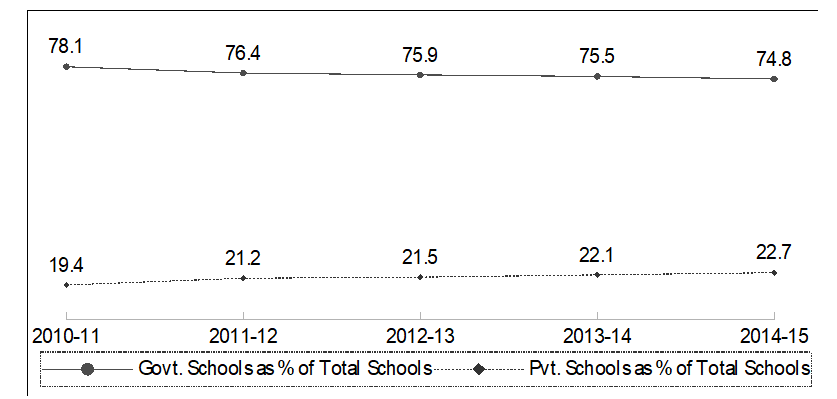
Consequently, four years after the passage of the RTE Act, the share of private unaided schools in total elementary schools in the country rose from 19.4 percent in 2010–11 to 22.7 percent in 2014–15, while government schools declined from 78.1 percent to 74.8 percent (Chart 3.1). In 2014–15, for the first time since independence, the total number of elementary schools fell—from 14.49 lakh to 14.46 lakh—as 13,200 government schools closed. Although 8,850 private schools opened, it was not enough to compensate for the decrease in government schools (see Chart 3.2).
Chart 3.1: Elementary Education: Private Schools and Government Schools as a % of Total Schools, 2010–11 to 2014–15
Source: Elementary Education in India: Trends 2005–06 to 2014–15, NUEPA, New Delhi, 2015, http://dise.in.
Chart 3.2: Elementary Education: Total Schools, Government Schools and Private Schools,
2010–11 to 2014–15(in ’000)

Source: Same as Chart 3.1.
More disconcertingly, total enrolment in elementary schools also declined—from 19.97 crore in 2012–13 to 19.77 crore in 2014–15—a decline of more than 20 lakh within just 2 years (Chart 3.3). This occurred even though the school-age population was growing annually by 3.8 percent (Census 2011).[32]
This decline is primarily due to falling enrolment in government elementary schools, which dropped from 13.01 crore in 2010–11 to 11.9 crore in 2014–15—a decline of 1.1 crore students in four years. Chart 3.4 gives the share of government schools in the total enrolment in all elementary schools in the country—in just four years, it fell by more than 7 percentage points.
Chart 3.3: Elementary Education: Total Enrolment in All Schools, Government Schools and Private Schools, 2010–11 to 2014–15 (in crore)

Source: Same as Chart 3.1.
Chart 3.4: Elementary Education: Student Enrolment in Private Schools and Govt. Schools as % of Total School Enrolment, 2010–11 to 2014–15

Source: Same as Chart 3.1.
This decline in enrolment disproportionately affected girls. After decades of steady progress, the share of girls in school enrolment declined at both primary and upper primary levels. Primary enrolment fell from a peak of 48.5 percent in 2009–10 to 48.2 percent in 2014–15. And at the upper primary level, it reached a high of 48.8 percent in 2012–13 after which it declined to 48.6 percent in 2014–15.[33] As education gets increasingly commercialised, parents are going to find it difficult to pay the rising fees, and they are likely to withdraw their daughters from school first.
The rapid pace of privatisation of school education becomes more evident when viewed across all schools. In 1986, private unaided schools accounted for 4.4 percent of the total schools, and 6 percent of the total enrolment (Table 3.1). By 2014–15, they accounted for 19 percent of the total schools and 30.6 percent of the total enrolment (Table 3.2). Government schools fell from 85.3 percent to 73 percent, and government school enrolment from 72.8 percent to 55.6 percent, over this period.
Table 3.2: Total Schools, Government Schools and Private Schools, 2014–15
| Total Schools | Government Schools | Private Unaided Schools | |
| Number of Schools | 15,16,892 | 11,07,118 (73%) | 2,88,164 (19%) |
| Student Enrolment | 25,94,70,306 | 14,41,44,802 (55.6%) | 7,92,73,408 (30.6%) |
Note: Figures in brackets are % of total; Total schools means schools from Class 1 to 12; Government schools does not include Government-aided schools.
Source: UDISE Flash Statistics 2017–18, NIEPA, New Delhi, http://udise.in/flash.htm.
Notes
8. National Policy on Education-1986 (henceforth, NPE-1986),MHRD, May 1986, https://ncert.nic.in/pdf/nep/Policy_1986_eng.pdf. The same statement, with slight modifications, is repeated in: National Policy on Education-1986 (with Modifications Undertaken in 1992) (henceforth, NPE-1992), Section 5.8, https://www.education.gov.in.
9. Cited in: Anil Sadgopal, “Dilution, Distortion and Diversion: A Post-Jomtien Reflection on Education Policy”, published in Ravi Kumar (ed.), The Crisis of Elementary Education in India, SAGE Publications, New Delhi, 2006, pp. 92–136. Also see: “Report of the Committee for Review of National Policy on Education 1986”, Section 6.2.3, 26 December 1990, https://www.educationforallinindia.com
10. NPE-1986, op. cit.; and: NPE-1992, op. cit.
11. Ibid.
12.All data on education expenditure from:Statement Indicating the Public Expenditure on Education, Ministry of Education, Government of India, https://www.education.gov.in.
13. Challenge of Education – A Policy Perspective, Ministry of Education, 1985, https://cprindia.org. Also see: Anil Sadgopal, “Dilution, Distortion and Diversion: A Post-Jomtien Reflection on Education Policy”, op. cit.
14. NPE-1986, op. cit.; and: NPE-1992, op. cit.
15. Summarised from: Anil Sadgopal, “Dilution, Distortion and Diversion …”, op. cit.; Anil Sadgopal, “Right to Education vs. Right to Education Act”, op. cit., pp. 29–32; Anil Sadgopal, “India’s Education Policy: A Historical Betrayal”, Combat Law, May–August 2009, pp. 20–21, http://combatlaw.org.
16. Anil Sadgopal, “India’s Education Policy: A Historical Betrayal”, ibid., pp. 21–24; Anil Sadgopal, “Dilution, Distortion and Diversion …”, ibid.
17. Muchkund Dubey, “Right of Children to Free and Compulsory Education Bill, 2009: The Story of a Missed Opportunity”, Mainstream, 19 September 2009, http://www.mainstreamweekly.net.
18. Estimates made by Prof. Anil Sadgopal, the eminent Indian educationist, cited in: Lokesh Malti Prakash, “Education in the Neo-Liberal Limbo”, 2 November 2012, http://khwabesahar.wordpress.com.
19. Anil Sadgopal, “Political Economy of the Ninetythird Amendment Bill”, Mainstream, 22 December 2001, http://www.doccentre.net; Anil Sadgopal, “Education for Too Few”, Frontline, 5 December 2003, https://frontline.thehindu.com.
20. “Education for All: Towards Quality with Equity”, NUEPA, 2014, p. 113, http://mhrd.gov.in.
21. Anil Sadgopal, “Neoliberal Act”, Frontline, 15 July 2011, http://www.frontline.in.
22. Ambarish Rai, “Misguided Education Policy in Rajasthan”, Economic and Political Weekly, 18 July 2015, http://www.epw.in.
23. “Private Schools Fill Just 15% of 2.2 Mn Seats Reserved for Poor Students”, 10 March 2016, http://www.livemint.com.
24. J.B.G. Tilak, “On Allocating 6 Percent of GDP to Education”, op. cit.
25. J.B.G. Tilak, “Financing the Implementation of Right to Education Act”, Budget Track, September 2010, Centre for Budget and Governance Accountability, New Delhi, www.cbgaindia.org.
26. Twelfth Five Year Plan, 2012–17, Vol. III: Social Sectors, p. 54, https://nhm.gov.in.
27. See for instance: Scheme and Guidelines for Financial Support to Public Private Partnerships in Infrastructure, Ministry of Finance, 2013, https://www.pppinindia.gov.in.
28. Eleventh Five Year Plan 2007–12, Volume II, p. 9, https://www.niti.gov.in. See also: J.B.G. Tilak, “Public–Private Partnership in Education”, 4 December 2021, https://www.thehindu.com.
29. See, for instance: Shishir Prashant, “To Fight Inefficiency, Uttarakhand Adopts PPP Model for Its Schools to Fight”, 31 October 2012, http://www.business-standard.com; “Haryana Follows Punjab Model to Set Up Schools”, 6 April 2011, http://www.indianexpress.com; Public Private Partnership In School Education, http://www.azimpremjifoundation.org.
30. Jasleen Kaur, “RTE Nearing 5 Years, 1 Lakh Schools Shut Down Across India: National Forum”, 28 October 2014, http://www.governancenow.com. See also: Ruchi Gupta, “How the Rajasthan Government is Throwing Children Out of School”, 27 November 2014, http://www.dailyo.in.
31. “Privatising BMC Schools an Assault on Education: Experts”, 23 July 2013, http://www.themetrognome.in; “Keep Off Education”, Economic and Political Weekly, 8 June 2013, http://schoolchoice.in.
32. Geeta Gandhi Kingdon, “Schooling Without Learning”, 8 February 2016, http://www.thehindu.com.
33. Elementary Education in India: Trends 2005–06 to 2014–15, NUEPA, New Delhi, 2015, http://dise.in.
[Neeraj Jain is a social activist and writer. He is the convenor of Lokayat, an activist group based in Pune. He is also the editor of Janata Weekly, India’s oldest socialist magazine. He has authored several books, including Globalisation or Recolonisation?, Education Under Globalisation: Burial of the Constitutional Dream, Nuclear Energy: Technology from Hell, and most recently, Union Budgets 2014-24: An Analysis.]