[This article is a part of a series of articles on India’s Education Journey from Macaulay to NEP. This is the second part of this series. The previous article was published in the previous issue of Janata Weekly.]
A: The Nehruvian Model
Introduction
W.E.B. Du Bois, the African–American sociologist, historian, author, editor and one of the foremost civil rights leaders of the United States, wrote that India’s freedom in 1947 was an event of greater significance for the world than the establishment of democracy in England, the emancipation of slaves in the United States, and the Russian Revolution, “for on that date, four hundred million coloured folk of Asia were loosened from the domination of white people of Europe.”[1]
The task before the newly independent country was Herculean: two centuries of colonial loot had reduced India to one of the world’s poorest nations, plagued by famines that claimed countless lives, with an average life expectancy shockingly low at about 30 years.
The reason why Mahatma Gandhi chose Nehru as his successor was because Nehru quintessentially represented and fought for all the core values of the Indian freedom struggle which have in short been called ‘The Idea of India’. These core values were sovereignty, democracy, secularism, pro-poor orientation and modern scientific outlook. Nehru played a stellar role in implementing these ideas in the newborn State after independence.
Nehru put in a tremendous effort to undertake the stupendous task of building a modern democratic nation in a country ravaged by communal riots in which millions had died, leaving the society deeply divided along religious lines: of keeping the country united despite its immense diversity; of combating the threat posed by communal forces to the secular conception of India; of promoting modern industrialisation within the parameters of democracy in a backward and colonially structured economy; of finding the balance between growth and equity in an impoverished, famine-ridden country; of promoting democracy and empowering the people in a country crushed by 200 years of brutal colonial rule; of promoting the highest level of scientific education, a field left barren by colonialism; and doing all this consensually, without the use of force.[2]
Nehru’s Economic Policies
Mahatma Gandhi wanted India to follow a decentralised path of development to empower people both politically and economically. Since the overwhelming majority of India’s people lived in the villages, he wanted the country’s leaders to focus on village development, by revitalising agriculture and developing rural-based industries—both essential to provide employment to India’s teeming millions.[3]
However, independent India’s leaders led by Nehru ignored Gandhi’s advice. Nehru wanted to rapidly industrialise India, but not by adopting a path that would promote capitalism that concentrated land and capital in the hands of a few, with the others living on the verge of existence. Influenced by socialism, he wanted to combine economic growth with social justice and equality, drawing inspiration from the ‘planned economy’ model of the Soviet Union. But he was also wary of the authoritarian tendencies of the Soviet model. And so he advocated a ‘mixed-economy’ model—a synthesis of the two systems—in which basic and strategic industries would be in the public sector, and production of consumer goods in private hands. For Nehru, the most critical ‘socialist’ element in this was planned development, for which he set up the Planning Commission in 1950, with himself as its head.
Another important element of the Nehruvian model was imposition of restrictions on foreign capital to protect the nascent domestic industry, in both the public sector and private sector.[4]
Except for Nehru’s vision of a planned economy, most other essential features of his economic model were very similar to the so-called ‘Bombay Plan’ proposed by a committee of Indian capitalists led by J.R.D. Tata and G.D. Birla.[5] In 1947, the Indian capitalists preferred that infrastructural industries like railways, roads, oil, telecom, heavy machinery and electricity be set up in the public sector, as they had neither the capital nor the technology needed to set up these industries, and without the development of these industries, development of other industries was not possible. Furthermore, while the gestation period for projects in the infrastructural sector was long, returns on investment in these sectors were low. The capitalists preferred to invest their limited capital in the consumer goods industries where there were quick profits to be made. This was also the essence of the ‘mixed economy model’, which is why they supported it.
Nehru felt that with the Planning Commission deciding the orientation of the economy and with the infrastructural sectors in the public sector, capitalist growth would be restricted and the economy would gradually advance towards socialism. The Second Five Year Plan was in fact called a socialist plan, and the Lok Sabha even passed a resolution in December 1954 saying that the objective of the government’s economic policies was achievement of socialism.
Looking back, it is obvious that despite Nehru’s wishes, the ‘mixed economy’ model did not lead to the development of socialism; on the contrary, it laid the foundations for the development of capitalism in India. Discussing the reasons for this is beyond the scope of this short booklet.
Limitations of Capitalist Development in India
Several countries that gained independence after the Second World War adopted a similar path of development as India. While not all their leaders were socialist like Nehru, they were all fiercely nationalist. The economic development model they pursued, including Nehru’s mixed economy model, can broadly be called an ‘autonomous capitalist development’ model. In essence, they all strove to duplicate the industrial revolutions of the developed capitalist countries. The developed countries had implemented similar policies during the early phase of their capitalist development.[6]
However, replicating this model was simply not possible for India and other newly independent countries of Asia and Africa. The developed capitalist countries of Western Europe and America had financed their industrial revolutions by colonising and looting the countries of Asia, Africa and Latin America. And when their industrial revolutions took off, these same colonies also provided them with the huge quantities of raw materials as well as the markets needed for their industrial revolutions to continue without interruption.[7] The colonies also absorbed the surplus peasant population displaced from villages as capitalism penetrated the rural areas—around 50 million Europeans migrated to the ‘New World’ between 1820 and 1915.[8] In contrast, when India and other ex-colonial countries began their industrial revolution, they had no region to plunder to finance their industrial revolutions. On top of it, their economies were not only totally devastated, but also crippled, due to centuries of colonial plunder.[9] And so, within just two decades after independence, by the 1970s, their autonomous capitalist development models became crisis-ridden.
This is the most important reason for the failure of the efforts of India’s leaders led by Nehru and our leading capitalists like Birla and Tata to rapidly industrialise India along the lines of the Western capitalist countries.
During his last years, Nehru himself had started realising the limitations of his economic model, and the need to go back to Gandhiji’s teachings. Unfortunately, Nehru came to this realisation too late; he died before he could undertake any significant course correction.
Shortcomings of the Nehru Model
The strong right-wing lobby within the Congress sought to sabotage Nehru’s economic policies. In alliance with the landed upper castes, they ensured that only limited land reforms were implemented. Consequently, large masses of peasantry continued to wallow in desperate poverty. This seriously limited the growth of the market in the countryside. With focus on growth of large industries, industrial growth was also not sufficiently employment generating to create a significant increase in demand.
The biggest weakness of the Nehruvian model was that it made only limited investment in education, health and nutrition, which would have unleashed the inherent potential of the people. One important reason for the rapid development of the East Asian countries during the 1960s–70s (apart from the aid provided by the USA for geopolitical reasons) was that their governments invested heavily in providing welfare benefits to their people.[10]
The conservative elements within the Congress, rooted in traditionalist values and with sympathies towards fundamentalist values, ensured that no serious attempt was made to eliminate medieval backwardness. Religious backwardness, casteism and patriarchy continued to hobble the creative power of the masses.
With this brief background to the Nehruvian model, let us now discuss its approach towards education in greater detail.
B: Nehruvian Model and School Education
Nehru and Education
Jawaharlal Nehru saw education as essential for both individual and societal development. In a letter to Chief Ministers (13 July 1958), he wrote: “It is the quality of the human beings that counts…. Hence education and health are of high importance so as to produce that quality in the human beings…. it is right education and good health that will give the foundation for economic as well as cultural and spiritual progress.” [11]
At a conference of scientists and educationists, Nehru emphasised that the real wealth of a nation lies in its people, and education is essential to nurturing this quality. “I attach the greatest importance to education”, he said, adding that he would “sacrifice any number of factories” rather than compromise on education, “because it is the human being who sets up the factories and produces the things we want.” [12]
For Nehru, education was indispensable to democracy. Speaking at a UN Seminar in 1962, he said the right to vote was meaningless without informed participation—something only widespread education could ensure. “I feel that freedom from ignorance is as essential as freedom from hunger”, he declared. “Ultimately, it means that in order that your freedom should flourish, there must be a basic degree of educational development.” He consistently asserted, “We can hardly have a political democracy without mass education.”
He also stressed education’s role in national planning: “I do not see any future for planned work in a backward country without the spread of education.” [13]
Nehru considered education to be the most important tool for empowering the oppressed castes. “The only real way to help a backward group is to give opportunities of good education”, he stated.[14] He also supported affirmative action to uplift socially disadvantaged groups. When the Madras High Court struck down caste-based reservations, he moved the First Amendment Bill to the Constitution in 1951 to enable their continuation.[15]
Nehru was also a passionate advocate of women’s education. He famously said, “If you educate a man you educate an individual, however, if you educate a woman you educate a whole family.” [16] At the birth centenary celebration of Dr. D.K. Karve, he stressed that educating women was more important than educating men, as “one of the truest measures of a nation’s advancement is the state of its women. For, out of the women comes the new generation, and it is from their lips and from their laps that it begins to learn.”[17]
In line with this vision, Nehru placed education at the heart of the Five-Year Plans. Addressing the Education Ministers’ Conference in 1963, he said, “We talk about Five-Year Plans and development schemes…. Our first plan should be for universal education. Everything else, whether it is industry, agriculture or anything else which is important for us, will grow adequately only if there is the background of mass education and, of course, specialised education at higher stages.”[18] He called for a school in every village, asserting in 1959, “The peasant cannot progress unless he has education. This is basic.” [19]
At the same time, Nehru firmly believed that it was the State’s responsibility to provide education, and that this must be free:
It is the duty of the State to provide good education, and free education to every child in the country.[20]
Growth of School Education After Independence
During the Nehru years, despite the severe lack of resources due to two centuries of colonial loot, the Nehru Government gave high priority to investment in basic education. During the first three Five-Year Plans, an average of about 6.9 percent of the total Five-Year Plan expenditure was spent on education.[21] Consequently, the education system underwent a massive expansion.
When India became free from British rule, there were very few schools in the country, especially in the rural areas. The literacy rate was a woefully low 12 percent. Over the next two decades, the school education system hugely expanded, and spread to the remotest corners of the country. By 1970–71 (see Table 2.1):
- Total number of primary schools had doubled, secondary schools had gone up by five times, and higher secondary schools had gone up by more than eight times.
- Total student enrolment in primary education had tripled, in secondary education had gone up by six times, and in higher secondary education had gone up by more than eight times.
- Total number of primary school teachers had doubled, secondary teachers had increased by five times, and higher secondary teachers had zoomed by eight times.
Table 2.1: Growth of Education in India, 1950–90
| Primary | Upper Primary | Secondary | Higher Secondary | |
| Enrolment (in lakhs) | ||||
| 1950–51 | 191 | 31 | 12 | 4.2 |
| 1970–71 | 570 | 133 | 66 | 35 |
| 1988–89 | 957 | 309 | 184 | 92.1 |
| Institutions (in thousands) | ||||
| 1950–51 | 209.7 | 13.6 | 7.3 | 0.84 |
| 1970–71 | 408.4 | 90.6 | 36.7 | 7.09 |
| 1988–89 | 548.1 | 144.1 | 73.3 | 10.48 |
| Teachers (in lakhs) | ||||
| 1950–51 | 5.4 | 0.9 | 1.3 | 0.24 |
| 1970–71 | 10.6 | 6.4 | 6.3 | 1.9 |
| 1988–89 | 16 | 10.3 | 12.4 | 3.07* |
* Refers to the year 1982–83.
Source: N.V. Varghese and J.B.G. Tilak, The Financing of Education in India, UNESCO, Paris, 1991, http://unesdoc.unesco.org.
The government set a norm that a child should not have to walk more than 1 kilometre to a primary school and 3 kilometres to a secondary school (from their residence). By 1993–94, of the total 10.61 lakh rural habitations in the country, 93 percent of the habitations having a population of 300 or more had a primary school either within the habitation itself, or within a distance of 1 kilometre, and 88 percent of the habitations having a population of 500 or more had an upper primary school either within the habitation itself, or within a distance of 3 kilometres.[22]
Kothari Commission (1964–66)
In 1964, a month after Nehru’s death, the Government of India appointed the Education Commission under D.S. Kothari to review the education system and recommend policies for its development at all levels.
Submitted in 1966, the Commission’s report is considered to be a landmark in the history of Indian education. J.P. Naik, its member–secretary, described its vision as creating a democratic, secular, and egalitarian society rooted in science and spiritual values, where poverty, ignorance, and ill-health would be eliminated through humane use of scientific and technical knowledge. The Commission was of the view that the existing education system could not help the country realise this vision. It argued that the education system needed “radical changes” if it is to meet the purposes of building “a modern democratic and socialistic society”—reforms that would amount to “a revolution in education which in turn will set in motion the much desired social, economic and cultural revolution” (Section 1.17).[23]
We briefly discuss below two of the most important recommendations of the Commission.
i) Setting up a Common School System
The Indian Constitution forbids an education system that reinforces inequality and social stratification. The Kothari Commission made a strong plea for implementing this constitutional principle, and recommended establishing a ‘common school system’ to provide equitable education to all children, regardless of the economic status of their parents.
The Commission warned that elites have historically used education “as a tool for maintaining their hegemony and perpetuating values upon which it has rested” (Section 1.16). It noted growing “segregation” in India’s education system—a “minority of private, fee-charging, better schools meeting the needs of the upper classes and the vast bulk of free, publicly maintained, but poor schools being utilised by the rest”—that is widening the divide between classes (Section 1.36).
The Commission emphasised that in a democracy, education must help every individual realise their full potential (Section 1.15). In a country like India, it argued, the education system must bridge social divides and “promote the emergence of an egalitarian and integrated society” (Section 1.36).
Based on these observations, the Commission came up with the profound recommendation (Section 1.38):
If these evils are to be eliminated and the educational system is to become a powerful instrument of national development in general, and social and national integration in particular, we must move towards the goal of a common school system of public education
- which will be open to all children, irrespective of caste, creed, community, religion, economic conditions or social status;
- where access to good education will depend not on wealth or class but on talent;
- which will maintain adequate standards in all schools;
- in which no tuition fee will be charged.[24]
ii) Increase Expenditure on Education to 6 percent of GDP
The Commission conducted a comprehensive analysis of education financing in India—widely regarded as one of the finest of its time.
After reviewing post-1947 trends in educational expenditure and projecting future educational needs over the next 20 years, and after making detailed comparisons with other countries, the Commission recommended that “if education is to develop adequately”, the proportion of GDP allocated to education must rise from 2.9 percent in 1965–66 to 6.0 percent in 1985–86.[25]
This recommendation was so well-founded that it was later endorsed by several international bodies, including the UNESCO and the UNDP.[26]
Recommendations Not Implemented
The Kothari Commission’s recommendations were path-breaking. Had the then Central Government implemented them holistically, they could have transformed Indian society. Instead, the government implemented only select suggestions, like the 10+2+3 education structure, while ignoring the two most important recommendations mentioned above—setting up a ‘common school system’ and raising education spending to 6 percent of GDP.
Subsequent Central governments and all important education policy documents have acknowledged the Kothari Commission report, but have made no effort to implement these two key recommendations. Had the Government of India implemented the recommendation to establish a ‘common school system’, it would have been an important blow to India’s hierarchical society, and laid the foundations for a truly “democratic and socialistic society”.
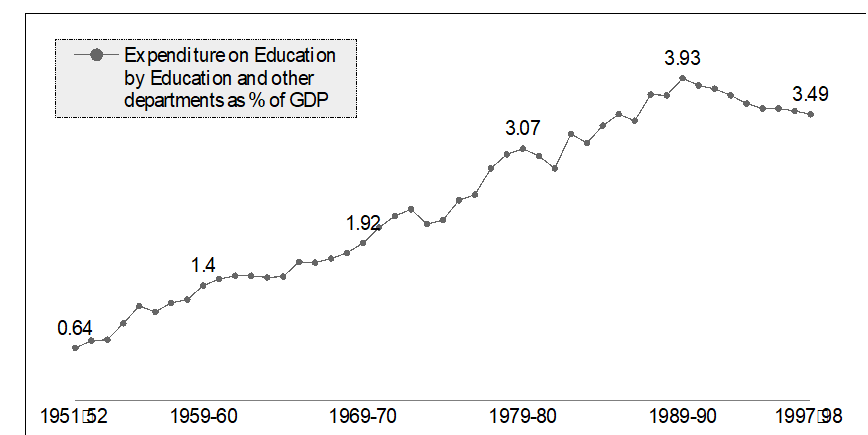
During Nehru’s prime ministership, education spending remained below 2 percent of GDP (Chart 2.1). Though the Kothari Commission called for raising this to 6 percent, and all later governments have echoed this goal, actual spending increased very slowly, to 3.5 percent by 1985–86 and 4 percent by 1989–90, only to fall back in the following years (see Chart 2.1).
Chart 2.1: India: Public Expenditure on Education as %of GDP
Source: Statement indicating the Public Expenditure on Education, Ministry of Education, Government of India, https://www.education.gov.in.
The reason for this low allocation to education was not lack of resources, it was more a question of priorities. Several developing countries invested heavily in universalising elementary education after winning independence. J.B.G. Tilak, one of India’s best known education economists, has analysed the education expenditure of a number of countries. He concluded that a nation’s education spending is not determined by the level of economic development, but by other factors, the most important being political will.[27]
This argument by Prof. Tilak is borne out by data for 1980 given in Chart 2.2. India’s public education spending at 2.9 percent of GNP was much below the developed and developing countries, as well as the world average. It was equivalent to the less developed countries.
Chart 2.2: Government Education Spending as % of GNP, 1980

Source: J.B.G. Tilak, Public Expenditure on Education in India: A Review of Trends and Emerging Issues, https://www.academia.edu.
Given India’s large population, our per-student expenditure was even lower than suggested by the above figures.
More Priority to Higher Education
Based on abundant research, all educational experts are of the opinion that investment in elementary education contributes more to economic growth and reduction in poverty as compared to investment in higher education. The Constitutional directive to universalise elementary education within 10 years also demands this.
Yet, both the Nehru Government and its successors ignored this priority. They were in a hurry to industrialise India. Since both public and private industry urgently needed engineers, scientists and technicians, after the First Five Year Plan, governments allocated a larger share of the limited education budget to higher education and, to a lesser extent, to secondary education. As Table 2.2 shows, elementary education’s share in the total Plan resources devoted to education fell from 56 percent in the First Five Year Plan to around 30 percent by the Fourth Plan; while university education’s share nearly trebled.
Table 2.2: Intra-Sectoral Allocation of Plan Outlays in Education in Five Year Plans
| Education Level | Expenditure Outlay | |||||||
| I | II | III | Ann. | IV | V | VI | VII | |
| 51–56 | 56–61 | 61–66 | 66–69 | 69–74 | 74–79 | 80–85 | 85–90 | |
| Elementary* | 56 | 35 | 34 | 24 | 30 | 35 | 36 | 29 |
| Secondary | 13 | 19 | 18 | 16 | 18 | 17 | 16 | 16 |
| University | 9 | 18 | 15 | 24 | 25 | 22 | 19 | 12 |
| Technical | 13 | 18 | 21 | 25 | 13 | 12 | 11 | 11 |
| Other° | 9 | 10 | 12 | 11 | 14 | 14 | 18 | 33 |
| Total | 100 | 100 | 100 | 100 | 100 | 100 | 100 | 100 |
* Includes pre-school education
° Includes teacher education, vocational and adult education, social education, cultural programmes, etc.
Source: Same as Table 2.1.
Educationists J.B.G. Tilak and N.V. Varghese have argued that had the First Plan’s pattern of intra-sectoral allocation of resources in the education sector continued, India might have achieved universal elementary education by the 1990s![28]
School Education System in Crisis
As we have seen above, the massive expansion of school education after independence led to opening of schools in the remotest corners of the country. Until the early 1990s, most of these schools were government schools and local body schools, with private unaided schools constituting just 4.1 percent of the total primary schools in 1993–94 (Table 2.3), in line with constitutional ideals.
Table 2.3: Primary Schools by Type of Management, 1993–94
| Government | Local Body | Private Aided | Private Unaided | Total | |
| Number of Schools | 2,54,606 | 2,70,806 | 21,557 | 23,486 | 5,70,455 |
| % of Total Schools | 44.6 | 47.5 | 3.8 | 4.1 |
Source: Sixth All India Educational Survey, Vol. 6, p. 3, available online at: dli.scoerat.14200sixthallindiaeducationalsurveyvolvl, https://archive.org
However, because of inadequate spending on elementary education, the quality of government and local body schools was dismal. Many schools operated in open spaces, exposing children to heat, cold and rain. Of the total government and local body schools (see Table 2.4):
- 35 percent lacked pucca buildings.
- They had an average of 1.7 classrooms and 2.6 teachers per school, forcing teachers to teach multiple classes in the same classroom.
- Just 63 percent classrooms had usable blackboards.
- Only 41.4 percent schools had drinking water facilities, and 7.6 percent had toilets.
Table 2.4: Facilities in Primary Schools, 1993–94
| School Management | Average Number of Classrooms | % Schools with Pucca Buildings | % Schools having Drinking Water | % Schools having Lavatory | % Classrooms having Blackboards | Average Teachers per School |
| Government | 1.64 | 56.3 | 34.6 | 6.0 | 54.3 | 2.4 |
| Local Body | 1.84 | 73.2 | 47.8 | 9.1 | 70.4 | 2.8 |
| Total (Govt + Local Body) | 1.74 | 65 | 41.4 | 7.6 | 62.8 | 2.6 |
Source: For first two rows: Columns 2–6: Arun C. Mehta, Education For All in India with Focus on Elementary Education: Current Status, Recent Initiatives And Future Prospects, NIEPA, New Delhi, February 2002, https://www.niepa.ac.in. For Column 7: Sixth All India Educational Survey, Vol. 3, p. 3, NCERT, 1998, https://archive.org. Last row, calculations done by us, using data from Table 2.3.
This neglect led to alarming outcomes. As per official data for 1990–91,
- 31 percent of children aged 6–10 and 28 percent of those aged 11–13 were not in school. [29]
- The drop-out rate at the primary level was 39 percent, and at the upper primary level was 22.3 percent (that is, of 100 children who took admission in Class I, only 22 completed elementary education)! [30]
This was a grave violation of Article 45 of the Constitution that directed the Indian State to provide “free and compulsory education to all children” up to the age of 14 years within ten years of its adoption. Four decades later, nearly one-third of children were still out of school, and nearly 80 percent of those enrolling in Class I dropped out before completing elementary education.
C: Nehruvian Model and Higher Education
Nehru inherited an India that had been brutally ravaged by two centuries of colonial rule. In just the decade before India won independence, the country had seen two genocides, the Bengal famine and partition. Apart from the huge influx of refugees who had lost homes and families, the country was crippled by poverty, hunger, deindustrialisation and an unskilled workforce. Nehru realised that to face these challenges, the country needed to develop, which required the building of a robust higher education system that could produce the educated workforce needed for this development in fields like humanities, engineering, research and industrial management. During his seventeen years at the helm, Nehru spearheaded the creation of an extensive network of universities, colleges and research institutions across India, including several that rank among the finest in the developing world.
Objectives of Higher Education During Nehruvian Period
Being a philosopher–statesman, Nehru envisioned India’s universities as more than centres of learning. He believed they must be imbued with a spirit of social concern and a commitment to national development. In his 1947 convocation address at the Allahabad University, Nehru thus summed up the basic objectives of the university and its role in national life:
A university stands for humanism, for tolerance, for reason, for the adventure of ideas and for the search of truth…. If the universities discharge their duties adequately, then it is well with the nation and the people.[31]
Soon after independence, the government set up the University Education Commission in 1948 under Dr. S Radhakrishnan to review university education and suggest reforms. The Commission, in its report, emphasised that all our education institutions must be guided by the ideals outlined in the Draft Constitution’s preamble—“justice, liberty, equality and fraternity” (Section 6).[32]
The Kothari Commission (1964–66) begins its section dealing with the objectives of higher education by reaffirming Nehru’s vision cited above. It then goes on to say that universities also bear special responsibilities in the present state of our social and educational development. It memorably declared:
Universities are pre-eminently the forum for a critical assessment of society—sympathetic, objective, unafraid … (Section 11.04)[33]
Principles of Governance of Universities During Nehruvian Period
In the early decades after independence, India’s political leadership remained deeply committed to national integration and the constitutional values of democracy, liberty, secularism and equitable development. This commitment extended to higher education. It sought to implement the visionary recommendations of the Radhakrishnan and Kothari Commissions, and create universities grounded in human values and a larger social purpose.
The Kothari Commission had eloquently observed that universities “are the dwelling places of ideas and idealism”, fostering a pursuit of truth and excellence that demands courage, fearlessness, integrity and mutual learning (Section 11.01).[34] To create such universities, it is essential that:
i) Higher education be entirely State-funded: For private investors, education is a commodity, a product that needs to be sold in the market to make a profit. They will prefer to offer courses like engineering and management which can fetch students a high-paying job and for which therefore they can charge high fees. This reduces students to consumers who have to buy education—their aim of acquiring higher education will then be personal gain, and not serving the nation and the people. For example, students paying high fees to take admission in medical colleges will not be interested in enrolling for a degree in preventive medicine which seeks to increase health consciousness of the people so that they don’t fall sick; they will be more interested in pursuing such specialisations that will enable them to make money by treating people when they fall ill. Therefore, if our higher education institutions are to be places where teachers and students have a spirit of social concern and strive to jointly work to address the problems facing the country, then they must be State-funded.
ii) Universities must have autonomy, and academic freedom must be respected: The Radhakrishnan Commission stressed that while the State must support higher education, it must not seek to control it. Universities must remain spaces of free inquiry, where teachers can speak on controversial issues without fear. This freedom is essential for nurturing what the Commission called the “morality of the mind” (Section 29).[35] The Kothari Commission had also powerfully stated that if universities are to be a “forum for a critical assessment of society”, they must foster a culture that values “individuality, variety and dissent, within a climate of tolerance” (emphasis added) (Section 11.05).[36]
During the Nehruvian period, at least till the late 1980s, the governments at the Centre and the States upheld both the above principles in governance of universities.
Growth of Higher Education, 1947–90
After independence, there was rapid growth of higher education institutions in the country, most of which were government funded. Over the four decades from 1950–51 to 1990–91, both the number of universities and the number of colleges went up by several times. Enrolment in higher education zoomed, going up from 4 lakh to 49 lakh over this period. Even more remarkable was the growth in enrolment of girls in higher education: their share in total enrolment went up from 10.8 percent to 29 percent (Table 2.5).
Table 2.5: Growth of Higher Education in India, 1947–91
| Universities* | Colleges | Enrolment in ‘000 | Girls Enrolment in ‘000 | Teachers in ‘000 | |
| 1950–51 | 30 | 695 | 397 | 43 | 24 |
| 1960–61 | 55 | 1,542 | 1,050 | 170 | 60 |
| 1970–71 | 103 | 3,604 | 1,954 | 431 | 129 |
| 1980–81 | 133 | 4,722 | 2,752 | 749 | 193 |
| 1990–91 | 190 | 7,346 | 4,925 | 1,437 | 263 |
* Includes Central and State Universities, Deemed Universities, Institutes of National Importance, and Private Universities.
[Note: Figures of student enrolment & teaching staff (1970–71 onwards) pertain to regular courses in universities & colleges (it excludes polytechnics, other diploma awarding institutions & non-formal systems of higher education)]
Source: Higher Education in India at a Glance, UGC, February 2012, http://www.ugc.ac.in.
As per official data, the enrolment of students from Scheduled Castes (SC) and Scheduled Tribes (ST) in higher education more than doubled over the period 1957 to 1987, from 1.07 lakh to 2.53 lakh.[37]
Nehru’s Vision for Science in Nation-Building
Nehru had deep faith in science and saw it as the motive force in India’s social and economic transformation. He believed that “science alone that can solve the problems of hunger and poverty, of insanitation and illiteracy, of superstition and deadening customs and traditions.” This vision was articulated in the Science Policy Resolution adopted by Parliament on 4 March 1958, which emphasised that national prosperity in the modern age rested on combining technology, raw materials, and capital—with technology being the most crucial.[38]
Consequently, Nehru prioritised the rapid growth of scientific and technical education in India.
i) Motivated the Best Scientists to join India’s Scientific Programme: Nehru viewed science not just as a means for scientific and industrial development. For him, it was a dream, an imagination—towards building an India that would stand tall through self-reliance rooted in scientific progress. His passionate nationalism, compelling vision and persuasive charm convinced India’s finest scientific minds—many of whom had gone abroad to promising careers—to join the nation’s scientific programme. These included:
- Homi J. Bhabha, who led India’s atomic energy programme.
- Vikram Sarabhai, pioneer of India’s space programme.
- Satish Dhawan, who headed ISRO and transformed India’s space programme into a world-class institution.
- S.S. Bhatnagar, founder of India’s world-class national laboratories.
- Meghnad Saha, top physicist–planner, founder of Saha Institute of Nuclear Physics.
- Daulat Singh Kothari, moderniser of India’s defence science.
- M.S. Swaminathan, whose research laid the foundations for India’s Green Revolution.
These are just a few leading names among a constellation of brilliant minds who helped Nehru lay the foundations for India’s scientific and industrial revolution within a few decades.
ii) Building Scientific Institutions: Post-independence, Nehru initiated the establishment of one of the best scientific infrastructures among decolonised nations:
- Under the aegis of the Council of Scientific and Industrial Research, 22 world-class national laboratories were set up between 1948 and 1958.
- In 1948, the Atomic Energy Commission and in 1954, the Atomic Energy Establishment, Trombay were set up for developing a self-reliant atomic energy programme for India.
- In 1958, the Defence Research and Development Organisation (DRDO) was set up for defence research and manufacture of defence-related equipment.
- With the launch of Indian National Committee for Space Research (INCOSPAR) in 1962, India began its space journey. A year later, the first rocket was launched from Thumba.
iii) Promotion of Technological Education: Nehru was conscious that large-scale scientific and industrial projects would need trained manpower:
- Nehru’s visit to the Massachusetts Institute of Technology (USA) in 1949 led to the creation of the five iconic Indian Institutes of Technology—at Kharagpur, Bombay, Madras, Kanpur and Delhi—between 1950 and 1961. Over time, they produced top-grade engineers, scientists and technologists who contributed significantly to India’s economic development.
- He established Regional Engineering Colleges (RECs), now renamed as National Institutes of Technology (NITs), across India to decentralise technical education, making it more accessible to students from different regions.
- Pre-independence institutions like the Indian Institute of Science (Bangalore), the Indian School of Mines (Dhanbad) and Indian Statistical Institute (Kolkata) received substantial support and evolved into iconic institutions during the Nehru era.
- Premier management schools, the Indian Institutes of Management (IIMs) at Ahmedabad and Calcutta, were founded in 1961.
iv) Development of Medical Education: Recognising that healthcare was vital to nation-building:
- Nehru established the All India Institute of Medical Sciences (AIIMS) in 1956 as a premier institution for medical training, research and patient care. It was followed by Maulana Azad Medical College in 1958 and the Govind Ballabh Pant Institute of Postgraduate Medical Education and Research in 1961.
- Medical colleges were rapidly set up across the country. Their number increased from 15 in 1946 to 81 in 1965; their student intake rose from 1,200 to 10,000 over this period.[39]
v) Development of Agricultural Research: Recognising the importance of agricultural education and research to make India self-sufficient in food production:
- The Indian Council of Agricultural Research (ICAR) was restructured and expanded in 1949 to promote agricultural research in the country.
- India’s first agricultural university, G.B. Pant University, was founded in 1960 in collaboration with the University of Illinois.
- Research stations were set up nationwide to study crop improvement, pest control, soil conservation and irrigation methods.
vi) Result: These initiatives led to manifold increase in scientific and technological education and research:
- Scientific and technical personnel rose from 188,500 in 1950 to 731,500 in 1965.
- Undergraduate enrolment in engineering went up from 13,000 in 1950 to 78,000 in 1965.
- Agricultural students increased from 2,600 to 14,900 over the same period.[40]
vii) Cultural Institutions and Holistic Education: Nehru emphasised that education must nurture not just intellect but also aesthetic sensibility and moral values. And so he initiated the creation of several institutions to promote arts and culture:
- The Sangeet Natak Akademi, India’s national academy for music, dance, and drama, was established in 1952.
- The Lalit Kala Akademi, which focuses on promoting and developing visual arts like painting, sculpture, and crafts, was founded in 1954.
- The National School of Drama was established in 1959 to train and develop theater professionals.
Higher Education in Crisis
As discussed above, the efforts of Nehru and other progressive leaders of the newly independent countries to rapidly industrialise their economies were constrained by historical limitations—they lacked the capital, raw materials and markets needed to replicate Europe’s industrial revolution. As a result, by the late 1960s and early 1970s, the Indian economy gradually sank into crisis.
This affected higher education too. As the Nehruvian model became crisis-ridden, the early post-independence idealism faded. The vibrant intellectual environment of the 1950s–60s declined; and universities increasingly became degree-granting factories producing educated workers, rather than centres for ‘nation-building’. During the 1950s–60s, the best students joined universities as teachers even though salaries were low, because they were keen to use their knowledge for the service of the country by imparting education to the young. By the 1980s, teaching had become a fallback option for those unable to secure better jobs.
Another factor that adversely impacted higher education was the compromise of the Congress Party’s right wing with medieval feudal values. After independence, Nehru sought to break India’s medieval feudal shackles and instil scientific temper and democratic values in the masses, but the conservatives within the Congress sabotaged his efforts. This affected our universities too—they continued to be plagued by political interference and the feudal values of casteism and regionalism. As idealism waned during the 1970s and after, these trends worsened.
A third important reason for the decline of the higher education system was inadequate public investment in education. Although higher education received 30–50 percent of total education spending between 1956 and 1985, overall funding was insufficient. While higher education hugely expanded, it began from a low base. Consequently, the expansion was inadequate as compared to our actual needs. In 1990–91, the Gross Enrolment Ratio in higher education (total enrolment in higher education as a percentage of the total youth population in the age group 18–23) was only 8 percent.[41]
Notes
1. Cited in Purushottam Agrawal, Who Is Bharat Mata?, Speaking Tiger Books, available free online.
2. See this series of articles for an excellent summary of Nehru’s contributions: Aditya Mukherjee, “Jawaharlal Nehru: A Guiding Force in Our Past, Present, and Future”, 10 January 2024, https://thewire.in.
3. G. Gangadhara Rao, “Inevitability of Gandhian Village Reconstruction in Rural India”, Mainstream, 6 October 2014, http://www.mainstreamweekly.net; Shelley Douglass, “Studying Gandhi: A Brief Introduction to Gandhi’s Life and Ideas”, http://www.context.org; Sudarshan Iyengar, “Gandhiji and Nehru on Economic Policies on the Eve of Independence and After”, Janata Weekly, Mumbai, 26 January 2018, https://lohiatoday.files.wordpress.com.
4. Brij Kishore Sharma, “Jawaharlal Nehru’s Model of Development”, Proceedings of the Indian History Congress, Vol. 73, 2012, https://www.jstor.org; H.K. Manmohan Singh, “Jawaharlal Nehru and Economic Change”, Economic and Political Weekly, August 1975, https://www.epw.in.
5. Aditya Mukherjee, Imperialism, Nationalism and the Making of the Indian Capitalist Class, Sage Publications, New Delhi, pp. 49–50, 358, 396–401.
6. Noam Chomsky, Class Warfare, Oxford University Press, Delhi, 1998, p. 19.
7. There are numerous studies on this. See for instance, Eduardo Galeano, Open Veins of Latin America, Monthly Review Press, New York, 1973.
8. Prabhat Patnaik, “The Myths of Capitalism”, 4 July 2011, https://mronline.org.
9. See for example: Walter Rodney, How Europe Underdeveloped Africa, London and Tanzanian Publishing House, Dar-Es-Salaam, 1973.
10. Joseph Stiglitz in Research Observer, World Bank, August 1996—quoted by Noam Chomsky in Profit over People, Madhyam Books, Delhi, 1999, p. 32; see also: “India and Its Contradictions: A Dialogue with Amartya Sen, Gurcharan Das, Meghnad Desai”, 28 July 2013, http://www.ndtv.com.
11. Jawaharlal Nehru, Letters to Chief Ministers, Volume 5, 1958–64, p. 89, https://ia800701.us.archive.org.
12. Speech While Inaugurating a Conference of Scientists and Educationists, New Delhi, 4 August 1963. Cited in: Jawaharlal Nehru’s Speeches, Volume 5, p. 145, https://ignca.gov.in.
13. Jawaharlal Nehru’s Speeches, Volume 4, pp. 182–83, 70–71, 149, https://ia601406.us.archive.org.
14. Jawaharlal Nehru, 27 June 1961, cited in: Jawaharlal Nehru, Letters to Chief Ministers, Volume 5, p. 457, https://archive.org.
15. Bastian Steuwer, “Constitutional Crossroads”, 30 April 2021, https://caravanmagazine.in.
16. Kumari Shibulal, “Empowerment of Women Through Education: A Critical Examination”, 17 April 2021, https://timesofindia.indiatimes.com.
17. Jawaharlal Nehru’s Speeches, Volume 4, p. 424, https://ia601406.us.archive.org.
18. Ibid., Volume 5, p. 149, https://ignca.gov.in.
19. Ibid., Volume 4, p. 131, https://ia601406.us.archive.org.
20. Jawaharlal Nehru, Speech at AICC Session, Avadi, 23 January 1955, cited in: Nehru on Social Issues, p. 117, Internet Archive, https://ia801406.us.archive.org.
21. J.B.G. Tilak, “The Kothari Commission and Financing of Education”, Economic and Political Weekly, 10 March 2007, https://www.epw.in.
22. Arun C. Mehta, Education For All in India with Focus on Elementary Education: Current Status, Recent Initiatives and Future Prospects, NIEPA, New Delhi, February 2002, https://www.niepa.ac.in.
23. J.P. Naik, The Education Commission and After, 1997, pp. 9–10, Internet Archive, https://ia601308.us.archive.org; Report of the Education Commission, 1964–66, p. 5, Internet Archive, https://archive.org.
24. Report of the Education Commission, 1964–66, ibid., pp. 4–5, 10.
25. J.B.G. Tilak, “The Kothari Commission and Financing of Education”, op. cit.; J.B.G. Tilak, “On Allocating 6 Percent of GDP to Education”, Economic and Political Weekly, 18 February 2006, http://www.nuepa.org. Note that the Kothari Commission had actually recommended 6 percent of GNP. In the 1960s, GNP was more commonly used as a key indicator in national accounting; over the years, GDP has become the more commonly used measure for assessing a country’s economic performance. For India, the numerical difference between GDP and GNP is usually not very large, especially when making broad policy recommendations. So, we have used GDP in place of GNP, as is the practice followed today by most experts while discussing Kothari Commission recommendations.
26. J.B.G. Tilak, “The Kothari Commission and Financing of Education”, ibid.
27. Ibid.; J.B.G. Tilak, “Political Economy of Investment in Education in South Asia”, International Journal of Educational Development, http://www.researchgate.net.
28. N.V. Varghese and J.B.G. Tilak, The Financing of Education in India, p. 30, UNESCO, Paris, 1991, http://unesdoc.unesco.org.
29. Arun C. Mehta, op. cit.
30. Our calculation, from the retention rate and transition rate given by Arun C. Mehta in ibid.
31. “Universities Stand for Tolerance”, The Nehru Blog, https://www.thenehru.org.
32. The Report of the University Education Commission (December 1948 – August 1949), p. 31, https://www.educationforallinindia.com. Note that this report was submitted in 1949, when the Constitution was still being drafted, hence it refers to the Draft Constitution.
33. Report of the Education Commission 1964–66, op. cit., p. 276.
34. Ibid., p. 274.
35. The Report of the University Education Commission (December 1948 – August 1949), op. cit., p. 42.
36. Report of the Education Commission 1964–66, op. cit., p. 276.
37. Calculated from statistics given in: Vijender Sharma, Crisis of Higher Education in India, Chapter 2, http://indiaeducrisis.wordpress.com.
38. Jawaharlal Nehru, Speech at the Indian Science Congress at Calcutta, 26 December, 1937. Cited in: Roshani Rai, “Jawaharlal Nehru’s Attitude Towards Science and Technology”, August 2023, https://www.researchgate.net.
39. “What did Nehru’s Public Sectors do for India?”, 25 February 2022, https://timesofindia.indiatimes.com.
40. Bipin Chandra et al., India After Independence 1947–2000, p. 141, Penguin Books, 2000.
41. J.B.G. Tilak, How Inclusive is Higher Education in India? 2015, http://www.educationforallinindia.com.
[Neeraj Jain is a social activist and writer. He is the convenor of Lokayat, an activist group based in Pune. He is also the editor of Janata Weekly, India’s oldest socialist magazine. He has authored several books, including Globalisation or Recolonisation?, Education Under Globalisation: Burial of the Constitutional Dream, Nuclear Energy: Technology from Hell, and most recently, Union Budgets 2014-24: An Analysis.]